
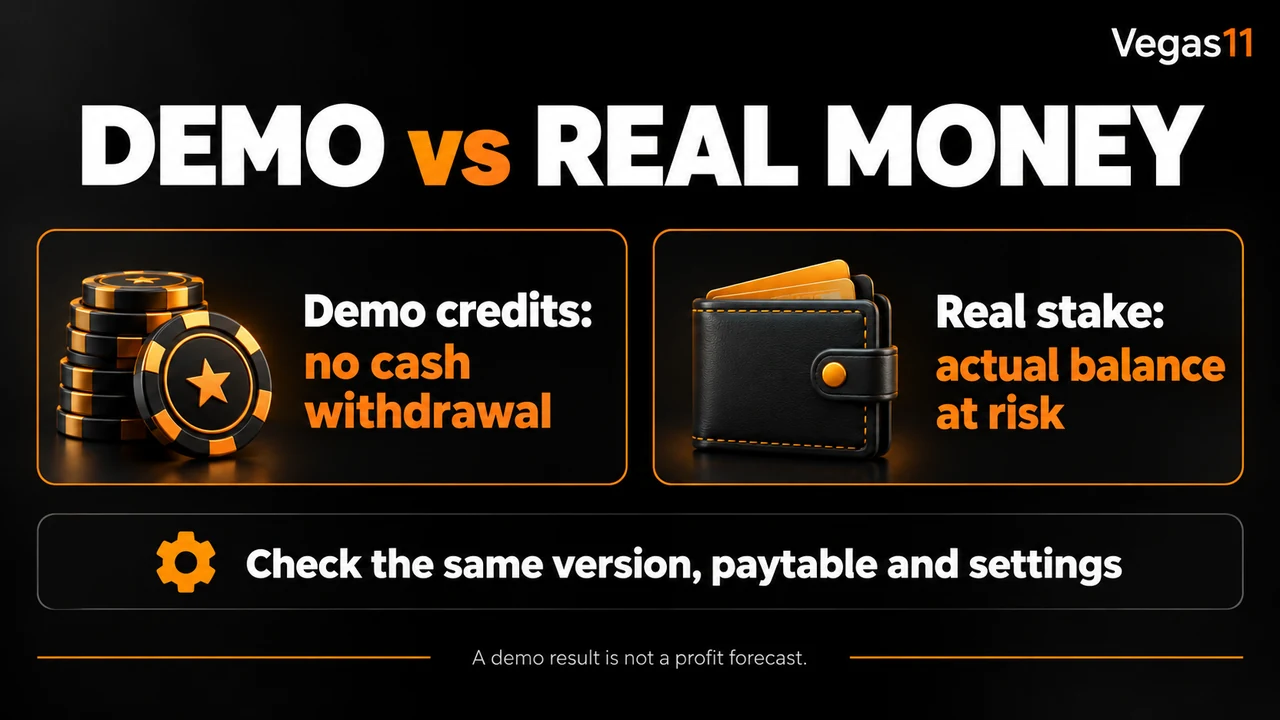
A slot demo can show you how to change the stake, read the paytable and follow a feature. It cannot tell you that your next real-money session will repeat the same returns. Virtual credits let you explore the interface without staking cash; they do not turn a short sequence of results into a forecast.
Check whether the demonstration matches the game you intend to open. Compare the supplier, exact title, version information and rule panel. A familiar logo or similar artwork is insufficient when the available settings differ. This guide does not claim that every Vegas11 game has a demo or that every demo uses identical settings.
Learn the controls before reading the results
Locate the total stake, sound controls, information menu and feature descriptions. Watch how an ordinary winning combination is credited. Identify which symbols count on lines and which qualify elsewhere. If a screen offers a paid feature, find its separate price rather than assuming the normal spin cost applies.
A demo is particularly helpful when a game has several menus or unfamiliar terminology. Practise opening the rules and returning to the main screen. You should be able to explain the amount a paid spin would commit without relying on the virtual balance. Knowing where a button sits is different from deciding whether to spend money on it.
Operator demos and supplier demonstrations
The British Gambling Commission’s play-for-free standard requires corresponding free and paid games on the same facility to use matching rules and representative probabilities. Its guidance also distinguishes supplier demonstrations designed to display bonus features. That is a regulatory reference for British licensees, not evidence of Vegas11 licensing or a universal certification of any demo you find.
A supplier promotional demonstration may therefore serve a different purpose from the free-play mode beside an operator’s paid game. Read any notice explaining adjusted demonstration behaviour. If the page does not establish the relationship between its demo and a paid version, keep your conclusion limited to the controls you actually saw.
Compare the rule panels side by side
Open the free-game information and the paid-game information without placing a wager. Compare the stated return setting, paytable, feature triggers, maximum payout and stake limits. A difference should be resolved before treating one screen as a guide to the other. Save the title and version details when asking support which configuration applies.
Our JILI return-percentage guide explains how to read a displayed RTP setting. The number describes a long-run mathematical expectation, not what a short practice session owes you. A game with several approved configurations may not use the setting mentioned in an unrelated review.
A practice win is not money waiting to be collected
Imagine a demo starts with 10,000 virtual credits and finishes at 12,000. You have observed a 2,000-credit change in that demonstration. You have not earned a withdrawable balance, and the result does not establish what the same number of paid spins will produce.
A large feature win in the demo is still a virtual-credit result. One memorable event can dominate your impression of a session. Read hit frequency versus RTP to separate how often a credited result appears from how much the game returns over its mathematical model.
Paid play adds conditions the demo cannot settle
A real account can involve identity verification, currency conversion, bonus restrictions and withdrawal conditions. A virtual-credit screen does not test those processes. Before funding an account, check the current terms and applicable local restrictions. Do not use a successful demo run as evidence that an operator will process a withdrawal in a particular time.
The Commission’s game-information standard provides a useful reference for clearly explaining rules and limits before a wager. Check the actual game rules and account terms for stake costs, verification and withdrawal conditions. If the total cost or a material condition remains unclear, postpone paid play.
Stop practice when it stops being useful
There is no required number of demo spins that proves readiness or profitability. Once you understand the interface and can read its rules, repeating rounds only adds more sample outcomes. It does not unlock a predictive pattern.
If you choose paid play where lawful, set a spending and time limit beforehand. The deposit-limit and time-out guide explains available control types. Keep that limit independent of the demo result. Practice can reduce confusion about controls; it cannot remove the possibility of losing the full amount you stake.