
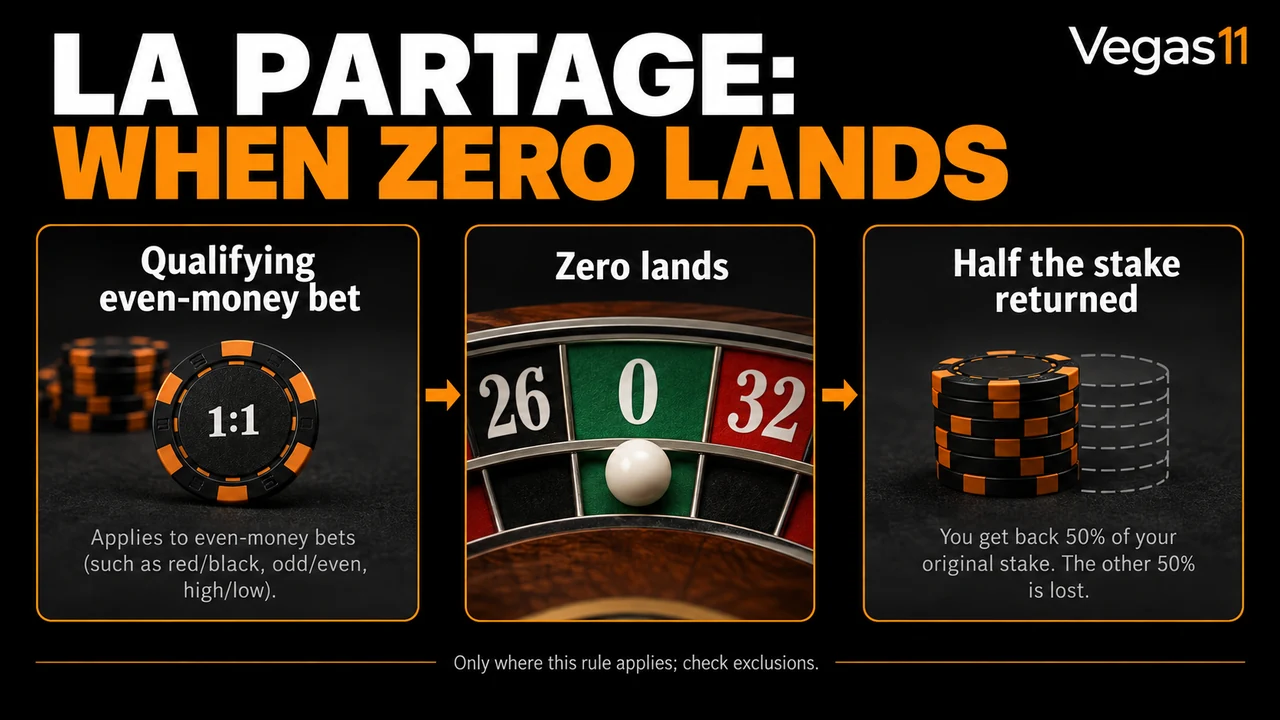
With La Partage, a qualifying even-money roulette wager loses half its stake when zero lands. The rule does not turn zero into a win, and it does not usually protect a one-number bet, dozen or column. Read the table’s eligible wagers and settlement rules before relying on the label.
For a hypothetical 20-unit red wager, an applicable half-loss rule would return 10 units and lose 10 when zero lands. That simple example is the heart of La Partage. It is a table-specific exception, not a reason to assume every French-looking or single-zero table offers it.
Which wagers qualify for La Partage?
Red/black, odd/even and low/high cover the standard even-money categories. Zero belongs to none of those winning selections. At a standard table without a protective zero rule, the eligible wager would lose its full stake on zero. La Partage changes that particular settlement.
Read the actual rule list rather than relying on the colour of the felt or the table’s name. Evolution’s roulette range explicitly describes French Roulette’s half-loss rule on even-money bets when zero lands. A supplier’s range is not proof that a particular table is available through Vegas11 or that all products use the same exceptions.
Follow a 20-unit bet through three results
Imagine a 20-unit wager on red. A red result wins at the table’s ordinary even-money payment. A black result loses the full 20. If zero lands and the La Partage clause applies, 10 is returned and 10 is lost. The partial return is not 10 units of profit.
Keep “returned amount” and “net result” separate when reading the balance. A player starting with 100 units would have 90 after that isolated zero settlement. Describing the returned 10 as a win would conceal the real decrease in the balance.
A second bet may have a different result
Suppose the same round contains 20 on red and 5 on a particular nonzero number. If zero appears, the protected red bet loses 10 under our example, while the one-number bet loses its full 5. The total loss is 15, not half of the combined 25 stake.
Our inside and outside roulette bets guide explains the categories. Do not divide the whole round stake by two unless every component actually qualifies. Each bet on the grid may settle differently, even though all use the same winning number.
The wheel layout still matters
A single-zero wheel contains 0 alongside the numbers 1 through 36. Find zero on the actual display using the roulette layout guide. The presence of one zero does not by itself establish La Partage, which is an additional payment rule.
The British Gambling Commission’s rule-disclosure reference calls for understandable game information before committing a wager. Use that as a clarity benchmark, not as a claim about this operator’s licensing. The version you open must explain which bets qualify and how they are settled.
What the half-loss changes over the model
On an equal-pocket single-zero wheel, a red wager has 18 winning numbers, 18 losing numbers and one zero. With ordinary even-money payment and the half-loss exception, the theoretical average loss is half a stake across 37 equally likely results, or about 1.35% of stakes. This is calculated from those stated assumptions, rather than measured from a session. The percentage applies to eligible wagers under that rule; it does not describe every chip placed on the table.
Check the history before challenging a payment
Preserve the table name, round identifier, winning number, individual bet amounts and credited return. If a qualifying 20-unit wager returns a different amount on zero, ask which rule accounts for it. A screenshot showing only the total stake may hide the separate bets needed to reconcile the record.
La Partage reduces the loss on a specific event; it does not remove losing rounds or make a staking system dependable. Increasing the next stake cannot force a red or black outcome. Use spending limits and time-outs when needed, and keep the amount you can afford to lose independent of the table’s zero exception.