
Gladiator’s Glory transforms a winning Wild into a Multiplier symbol after the round’s wins are paid. The possible values are ×2, ×3 and ×5. A Wild merely being visible elsewhere on a paying screen is not the same as that Wild being involved in the win.
The actual English game screens below show the change from flaming WILD to numbered sign, followed by a visible ×2-plus-×3 example. Free spins introduce a retained total below the reels, so the current signs, the retained value and the number of spins left need separate readings.
The arena grid is five reels with a taller centre
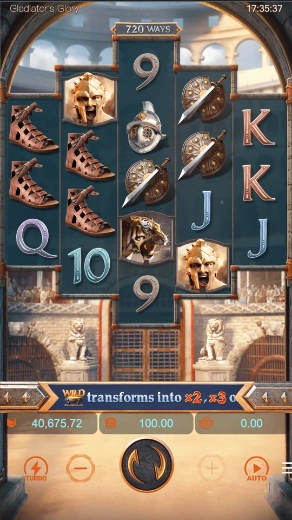
The first and fifth reels have three rows, the second and fourth have four, and the central reel has five. The 720 WAYS label sits above the grid. It describes the evaluation layout, rather than a current multiplier or an award of 720 free spins.
Ordinary pictures include helmets, sandals, shields and a tiger alongside card letters and numbers. The functional Wild is a flame over a brazier bearing WILD. It substitutes for eligible symbols except Scatter and appears on reels two, three and four only.
That substitution role comes first when deciding whether the Wild participates in a combination. The later numbered Multiplier sign has a different role in the feature calculation. Do not treat every fiery-looking object as both a substitution and a multiplier before the stated transformation has occurred.
The Wild must be part of the win
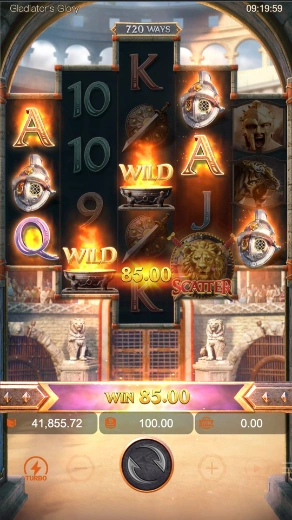
The feature condition is a winning Wild. After the round’s wins are paid, a Wild involved in a win transforms into a Multiplier symbol valued at ×2, ×3 or ×5. The example highlights two WILD flames with other paying symbols, which connects the transformation to an actual qualifying combination.
This is narrower than “the spin paid somewhere.” An unrelated winning group does not, by that fact alone, make every visible Wild a winning Wild. When checking the condition, identify which Wild supplied the qualifying combination instead of counting all flames on the screen.
The timing is after the win is paid in a round. It is not a feature that waits only for the end of the entire spin before considering whether a Wild won. A spin may contain several falling-symbol rounds, and that distinction matters when reading the change between the next two illustrations.
From WILD to ×2 and ×3
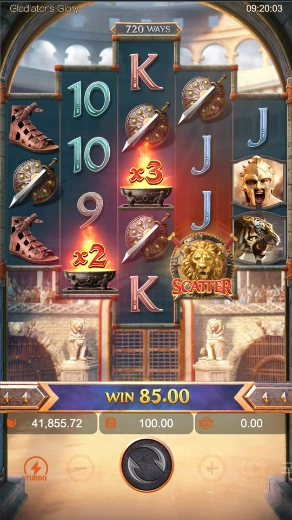
The transformed symbols now show ×2 and ×3 above their braziers. They are numbered Multiplier symbols in this state, rather than ordinary letters or a count of remaining Wilds. The cash Win display below is a separate field.
The rule specifies three possible values: ×2, ×3 or ×5. It does not describe every integer from two to five as an individual transformation result. In particular, a current combined total can be a different number from any one of the allowed individual signs.
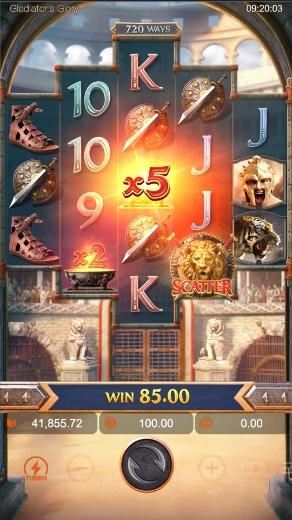
The supplied combination frame displays ×5 over the ×2 and ×3 signs. The visible arithmetic is 2 + 3 = 5. Using 2 × 3 would give six and would not match that illustrated total. The picture therefore provides a concrete reading of the combined signs, rather than requiring a rule imported from another Wild-multiplier game.
For a hypothetical completed main-spin state with those two values and an underlying win of 10, applying the confirmed combined multiplier of five gives 10 × 5 = 50. The invented underlying amount explains the operation. It is not a claim that an unpictured final cash result was paid from the 85.00 animation frame.
Keep the round transformation and end calculation separate
The Wild-to-Multiplier transformation follows the payment of a qualifying winning round. At the end of the spin, if Multiplier symbols are on the reels, the total win of the spin is subject to those multipliers under the documented feature rule. The symbols can change role before that final calculation point.
This prevents two common shortcuts: assigning a multiplier as soon as an ordinary Wild merely lands, or applying the transformation only after every internal round has already finished. The written condition needs both winning involvement and the specified after-payment timing.
| Visible state | Rule question |
|---|---|
| WILD flame on the grid | Does it substitute in a qualifying winning combination? |
| Winning WILD highlighted | Has that round’s win been paid for the transformation? |
| Numbered ×2, ×3 or ×5 sign | Which Multiplier values are present? |
| Combined multiplier animation | Does the arithmetic match those current values? |
| Cash Win field | What completed result is recorded at the calculation point? |
Ten free spins add a retained multiplier display

Three Scatters anywhere trigger ten free spins, with two extra spins for every additional Scatter. Free spins can retrigger. Wild substitution excludes Scatter, so a normal Wild is not an extra Scatter toward that entry count.
During free spins, awarded multipliers are added and retained below the reels until the feature ends. The opening screen names the ×2, ×3 and ×5 symbols and their contribution to the total. The retention period is this free-spins feature, rather than a permanently saved account multiplier.
At the end of a free spin with one or more Multiplier symbols on the reels, the formal rule includes both the current reel multipliers and the lower total in the win calculation. Do not discard one field just because the other is visually larger, or use a remaining-spin counter as a third multiplier.
The lower ×12 is not the same thing as four current signs
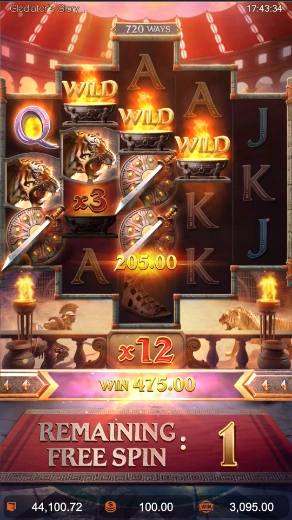
The illustrated free-spin state contains Wild flames and an existing ×3 sign, a lower ×12 and one remaining free spin. Those are three layers of information: the current grid’s symbol roles, the retained-total display and the counter for turns still left in the feature.
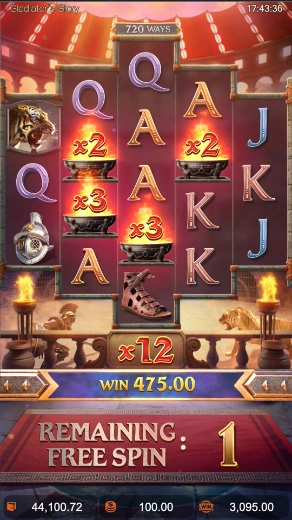
The next supplied transformation illustration has two ×2 signs and two ×3 signs while the lower display still reads ×12. Counting the current signs alone gives ten. That does not authorize replacing the lower total with ten, because the lower field represents retained information under the free-spins rule.
These animation states do not provide the entire history of retained awards or every later falling-symbol round. The article does not use them to invent a final cash result or assert a sequence of unshown updates. To reconcile a recorded free spin, identify the current signs, retained total and completed result at the applicable calculation point.
The maximum win uses a different unit
The specified maximum win is 5,000 times the bet amount. The manufacturer states that reaching that total in the main game or free-spins feature ends the spin. That monetary-result limit is separate from the 720 ways, the three possible individual sign values and the lower retained total.
A correctly identified winning Wild explains a documented transformation. It does not predict whether the next replacement symbols will form another win, whether another Wild will qualify, or whether the feature will reach a particular total. No such forecast follows from the current flames or the size of a multiplier badge.
Does every Wild wait until the end of the spin to transform?
The stated transformation occurs after wins are paid in a round and applies to winning Wilds. Keep that distinct from the end-of-spin multiplier calculation. Do not borrow another title’s may-transform-at-the-end condition.
Can a single transformed Wild show ×4?
The cited transformation values are ×2, ×3 and ×5. A combined or retained display can reflect several contributions, but that is different from the listed values of one newly transformed sign.
Source: PG SOFT, Gladiator’s Glory English game information, version 1.0.r4, pages 3–9, retrieved 18 November 2026. Images are actual manufacturer example game screens. They do not establish current availability or identical settings on Vegas11, and they are not an author’s play history.