
Werewolf’s Hunt starts its Bonus Feature with three bonus spins, while moon features can take up to five bonus spins to reach full phase. These are separate clocks. A new Prize Multiplier or coloured Moon symbol resets the bonus-spin counter to three; the passage of another moon phase is not itself the stated new-symbol reset condition.
The real English game screens below separate the counter, moon phases and symbol values. They also show why the main game’s wolf multipliers should not be read using the Bonus Feature’s prize-value rules, even when both displays use an x beside a number.
The main game has a different multiplier calculation
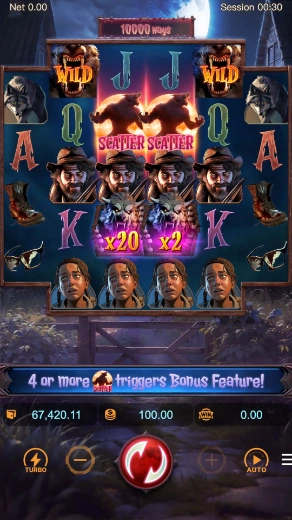
The main grid has six reels, with four rows on the outer two and five rows on the middle four. It displays 10,000 ways. During a main-game spin, one or more wolf Multiplier symbols with values from ×2 to ×20 may appear on the reels.
At the end of the spin, multiplier values on the reels are added, and the spin’s total win is multiplied by that total. The individual ×2-to-×20 range describes one main-game Multiplier symbol. It should not be treated as a rule saying every final sum must stay at or below 20.
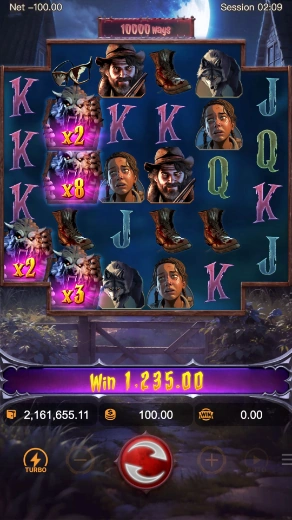
The illustrated main-game state has four values: ×2, ×8, ×2 and ×3. Their sum is 2 + 8 + 2 + 3 = 15. The cash Win field below is a different measurement, and the picture does not turn those four values into four extra bonus spins.
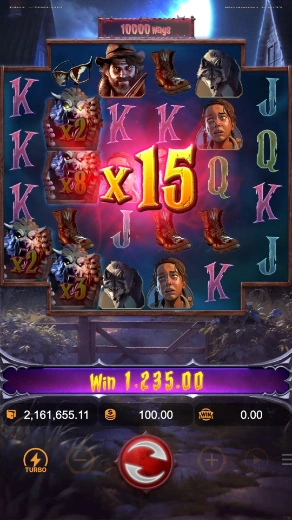
The next supplied frame displays a large ×15 over those multiplier pictures, matching the sum. Multiplying the four values together would give 96 and would apply a different rule. This checks the visible multiplier arithmetic without inventing an unpictured final cash payment from the intermediate animation.
Wild is another symbol role: it substitutes for eligible symbols except Scatter and appears on reels two to five. A regular Wild therefore does not fill in a missing Scatter toward the separate Bonus Feature trigger.
The Bonus Feature starts at three, not fifteen
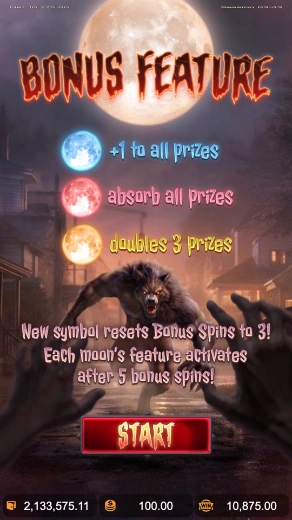
Four or more Scatters anywhere trigger the Bonus Feature. At entry, the Scatters become Prize Multiplier symbols with initial values from 1× to 3× the bet amount. Only Prize Multiplier symbols and blue, red or yellow Moon symbols appear on the bonus reels under the documented feature rule.
Three bonus spins are awarded at the start. Every new Prize Multiplier symbol, Blue Moon, Red Moon or Yellow Moon resets the counter back to three. The rule is a reset to a fixed value, rather than adding three for every new symbol.
For a hypothetical counter example, suppose one bonus spin remains and two new qualifying symbols appear. The reset rule returns the counter to three. It does not create one plus three plus three, or seven spins. Those numbers explain the counter operation; they are not a reconstructed sequence from the supplied screenshots.
The ×15 main-game animation earlier in the article is unrelated to this initial three-spin award. Neither that multiplier nor the 10,000-ways label is an alternative count of turns in the Bonus Feature.
Moon phases do not count the same thing as bonus spins left
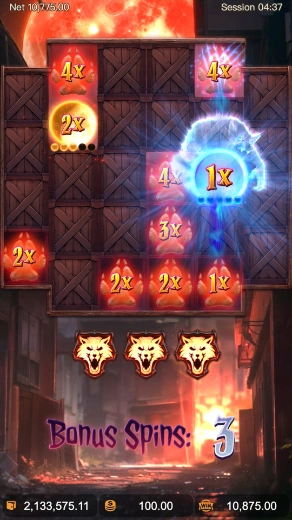
A blue, red or yellow Moon can appear partly formed and take up to five bonus spins to become full and activate its effect. After a moon has activated, it becomes completely dark and takes five bonus spins to reach full phase again. Its phase progress describes the moon’s own feature cycle.
The lower Bonus Spins counter says how much of the feature remains unless a qualifying new symbol resets it. It is not a direct countdown of every moon’s remaining phases. The official board example shows Bonus Spins 3 while a blue moon and other values occupy the grid.
These two clocks can coexist because new symbols can reset the bonus counter while moons progress through bonus spins. That possibility is not a guarantee: a moon that is close to full does not, merely by being close, supply the stated new-symbol event or keep the feature alive indefinitely.
The opening screen summarizes a five-spin moon cycle. The formal rule is more precise about entry states: a newly appearing partial moon can take up to five, while a moon that has activated goes dark and needs five again. Do not assume that every visible partial moon has exactly the same progress remaining.
Three colours, three different value effects
| Full moon colour | Documented effect | What the number means |
|---|---|---|
| Blue | Adds 1× to all symbol values on the bonus reels | An addition to prize values, not one extra bonus spin |
| Red | Absorbs all symbol values on the bonus reels | A collection effect, not the main-game multiplier sum rule |
| Yellow | Doubles three randomly selected symbol values | Three selected symbols, not every symbol on the board |
A blue moon’s +1 is measured in bet multiples attached to symbols. For a hypothetical symbol worth 2× the bet before that effect, adding 1× gives 3×. It does not turn a counter of two remaining bonus spins into three merely because the moon became full.
The red moon absorbs values from the symbols on the reels. That wording names the collection effect; it should not be expanded into an invented rule that all absorbed values are paid again separately or copied permanently into a second balance. A static frame does not resolve every update step or settlement detail.
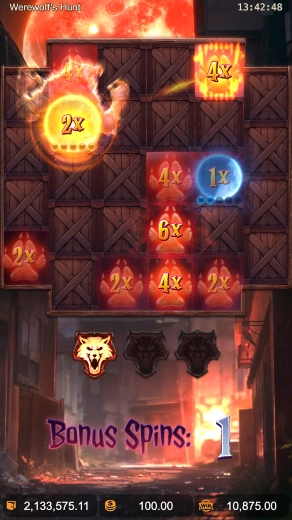
The yellow moon doubles three randomly selected symbols. If the three selected values in a hypothetical example are 1×, 2× and 3×, their doubled values are 2×, 4× and 6×. The operation does not say that every value doubles, or that the player chooses the three positions.
The supplied yellow-moon picture contains a 6× value even though new Prize Multiplier symbols begin at 1× to 3×. Later feature effects can change values, so the initial range is not a ceiling on every later number visible in the bonus board. The article does not assign an unshown history to each particular 4× or 6× symbol.
A remaining counter of one can still end the feature
The yellow-moon example displays Bonus Spins 1. The feature ends when the bonus-spin counter reaches zero. The rule does not add an exception saying that every moon must first become full, every dark position must be occupied or every colour must activate once.
An existing moon changing phase is not, just because its artwork changes, a newly arriving Moon symbol. Keep the written new-symbol reset condition separate from a phase update. Without a qualifying reset, progress toward full phase is not enough evidence to declare another three spins awarded.
The counter-three and counter-one screenshots are manufacturer examples of separate states. They are not an uninterrupted record of the author’s feature. They do not show all new arrivals, every phase update or the full chain of prior colour effects, so those events should not be invented from the order of the illustrations.
Bet multiples are not the same as cash labels
The Bonus Feature’s initial 1×-to-3× Prize Multiplier values are expressed relative to the bet. The main game’s ×2-to-×20 wolf symbols instead multiply a spin’s win through their summed value. The same printed 2x can therefore belong to two different calculations, depending on the mode and symbol role.
The documented maximum win is 10,000 times the bet amount. Reaching it in the main game or Bonus Feature ends the spin under the manufacturer’s rule. That result limit is separate from the 10,000-ways label, the bonus counter of three and the five-spin moon cycle.
Does a full blue moon add a bonus spin?
Its stated effect is +1× to symbol values. A new qualifying symbol resets the bonus-spin counter to three. Those effects should not be combined into an unstated rule that every full moon also grants a turn.
Does the next spin have to complete a partly filled moon?
No such guarantee follows from a static partial phase. Read that moon’s current progress and the remaining counter separately. The documented rules explain a state; they do not predict the next new symbol or assure that the feature lasts long enough for every moon to activate.
Source: PG SOFT, Werewolf’s Hunt English game information, version 1.0.r4, pages 3–9, retrieved 18 November 2026. Images are actual manufacturer example game screens. They do not establish current availability or identical settings on Vegas11, and they are not an author’s play history.