
Safari Wilds transforms winning symbols on reels three and four into Wilds at the next round after new symbols fall. The condition is not simply that a lion or letter landed inside a gold outline: that particular symbol must have been involved in the previous round’s win. Symbols on the other reels do not receive the same transformation just because they also paid.
The actual manufacturer screens below show the two central reels, highlighted winning symbols and a later Wild state. Free spins keep the transformation rule while doubling the multiplier ladder to ×2, ×4, ×6 and ×10. That ladder is separate from the remaining-spin counter.
The gold outlines identify two reels, not every special symbol
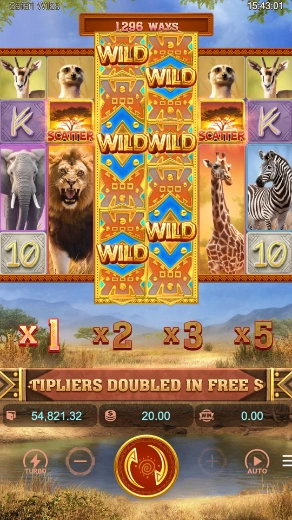
The game has six reels. The two central reels, three and four, have six rows; the outer four reels have five. Gold outlines make the taller central area easy to find. The featured manufacturer state shows many WILD patterns inside it, with ordinary animals and other symbols outside.
That particular grid is an example state. It does not mean every spin begins with two completely Wild reels or that every animal in the middle automatically becomes Wild on landing. The documented transformation needs its winning-symbol and next-round conditions.
The ways count above the grid varies with the displayed symbol arrangement, within the specified 400-to-22,500 range. Some symbols occupy two to three spaces and count as one symbol in payout calculations. A tall lion picture is not automatically several independent lions merely because it covers several positions.
Wilds appear only on reels three and four and substitute for eligible symbols except Scatter. This location restriction helps identify the feature’s central area, but it does not replace the written condition for turning an ordinary winning symbol into a Wild.
First identify the winning symbol inside the centre
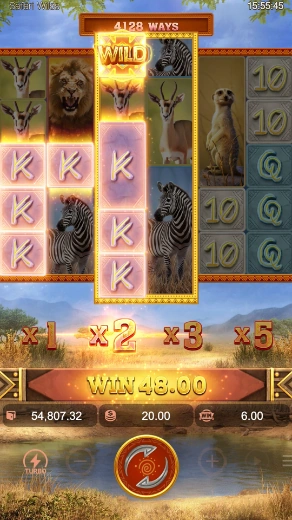
The illustrated winning combination includes highlighted K positions in a central reel and on earlier reels. The relevant question is not just whether a K won somewhere, but which winning K positions are on reels three and four. Those are the positions covered by this conversion rule.
At the next round after new symbols have fallen, eligible symbols in the two central reels that were involved in the previous round’s win transform into Wilds. The phrase previous round links the new state to a particular winning combination, rather than to the entire history of the session.
A winning symbol outside the central pair can be part of the same paid combination without receiving the central transformation effect. Conversely, an ordinary picture inside the gold border that was not involved in that win does not meet this stated conversion condition just because its neighbours did.
The next-round Wild state can still contain ordinary animals
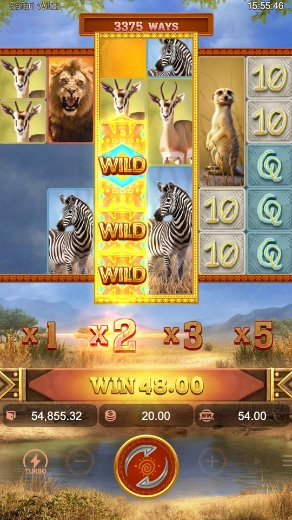
The following manufacturer transformation state has several WILD patterns in the outlined central area. Other positions retain animals and ordinary pictures. This is a selective rule based on qualifying prior winning positions, rather than a blanket instruction to replace the whole board.
The gold outline belongs to the reel area. It should not be confused with another title’s individual gold-framed symbol that changes after a different condition. Safari Wilds names the two transformation reels directly, so there is no need to import an extra silver-frame stage or a special collected-item count.
The round boundary is also distinct from starting another paid spin. A single spin can have a winning round, falling replacements and another evaluation. The conversion can occur within that sequence; it is not an instruction to place a separate wager to make the preceding K qualify.
The multiplier ladder follows winning rounds
In the main game, the first round uses ×1. A win in round one makes round two use ×2; a win in round two makes round three use ×3. A win in round three moves the fourth and subsequent rounds to ×5. The current multiplier is displayed below the reels.
This timing can coincide with a central transformation, because both concern winning rounds, but their conditions answer different questions. The ladder determines the multiplier for a round’s wins. The reel rule determines which prior winning positions become Wild. One should not be substituted for the other.
For a hypothetical second-round underlying win of 10, the main-game ×2 produces 20. The same invented underlying amount in a second free-spin round uses the mode’s ×4, producing 40. The example separates mode and round; it does not reconstruct the cash banners in the supplied pictures.
| Falling-symbol round | Main-game multiplier | Free-spin multiplier |
|---|---|---|
| First | ×1 | ×2 |
| Second | ×2 | ×4 |
| Third | ×3 | ×6 |
| Fourth and later | ×5 | ×10 |
The fourth-and-later value is the last step of each stated ladder. Continuing to a fifth falling-symbol round does not, by this rule, create another step of ×6 in the main game or ×12 in free spins. A free-spin counter of twelve is a different kind of information.
The counter can stay unchanged while the middle symbols transform
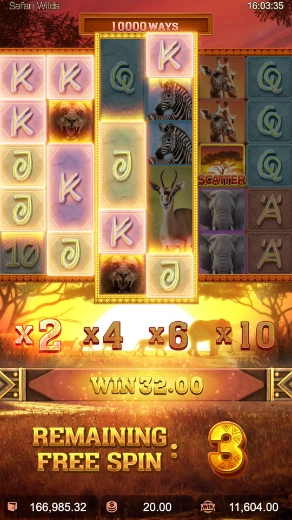
The free-spin example highlights K and J combinations including central positions, while the lower counter says three free spins remain. The active ladder begins at ×2 in this mode. Three is not a claim that the current multiplier must be ×3.
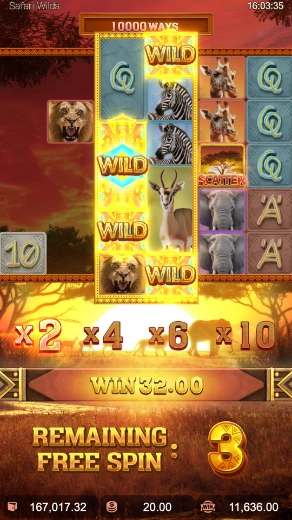
The paired transformation illustration shows Wilds in the central reels and still displays three remaining free spins. Internal falling-symbol rounds can occur within the same free spin; they do not each have to consume another item from the feature counter.
Ordinary pictures remain in parts of the outlined area. This makes the same point as the main-game example: the feature converts qualifying previous winning positions, not every position indiscriminately. The screenshots identify those rule states without serving as a complete author play history.
Four Scatters award twelve free spins

Four Scatters anywhere trigger twelve free spins. Each additional Scatter adds two, and free spins can retrigger. A Wild cannot be counted as another Scatter because its substitution rule excludes Scatter.
The opening screen explicitly lists ×2, ×4, ×6 and ×10 as the doubled multiplier values. Doubling describes the difference between the mode’s ladders. It does not say those values double again after every completed free spin, or that each transformed Wild independently doubles the entire cash result.
Some supplied frames retain their original localized game-title labels, while the ways, WILD and free-spin fields used here remain visible in the source. Those labels are preserved as supplied in the English manufacturer document; they have not been replaced with a manufactured interface or a Vegas11 availability claim.
Keep the maximum win separate from the ladder
The specified maximum win is 5,000 times the bet amount. The manufacturer states that reaching that total in the main game or free-spins feature ends the spin. That monetary limit is distinct from the ×5 or ×10 round steps and from the changing ways display above the grid.
Do all winning symbols turn Wild?
Only the stated winning-symbol positions on reels three and four follow this transformation rule. A symbol paying on an outer reel can belong to the same combination without receiving that conversion.
Does a central lion have to win before any Wild can ever appear?
The conversion rule requires the relevant ordinary symbol to have won. The separate Wild rule identifies where Wilds can appear. Do not turn the conversion condition into an unstated claim that every possible Wild must come from one particular animal or prior picture.
Source: PG SOFT, Safari Wilds English game information, version 1.0.r3, pages 3–10, retrieved 18 November 2026. Images are actual manufacturer example game screens. They do not establish current availability or identical settings on Vegas11, and they are not an author’s continuous play record.