
A sticky Wild in Mafia Mayhem does not always become a multiplier under the main-game rule: each Wild may randomly transform at the end of the spin. Free spins use a stronger condition—all Wilds transform into multiplier symbols at the end of the spin. In both cases, sticky describes retention until the current spin ends, rather than a symbol saved permanently.
The manufacturer’s actual English pictures show the distinction particularly well. One main-game example turns 55.00 into 550.00 through a single ×10. A free-spin example shows six multiplier signs and a final 9,460.00. The numbers can be read directly, without inventing a continuous author play session or treating every Wild as an automatic ×100.
Gold frames come before the sticky-Wild stage
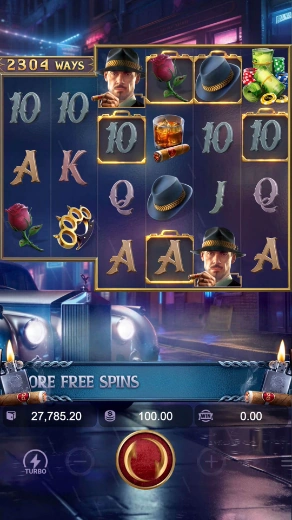
The game has six reels: three rows on the first two reels and four rows on reels three to six, giving 2,304 ways. In the illustrated state, ordinary letter, number and picture symbols on the later reels have gold frames. A framed ten is still a ten at this point; the frame is a feature condition, not a label saying that it is already Wild.
Eligible ordinary symbols on reels three to six may appear with a gold frame. Wild and Scatter are excluded from that group. A gold-framed symbol involved in a win changes into Wild at the next round after the new symbols fall. The condition is involvement in the preceding round’s win, rather than simply appearing somewhere on the grid.
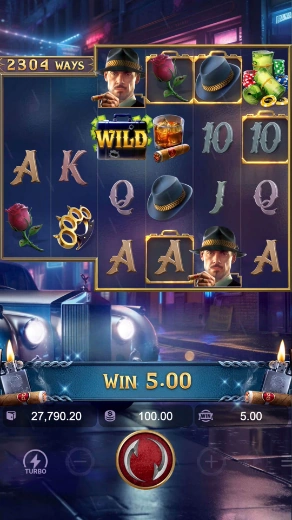
The rule illustrations show a framed ten in the third reel involved in a winning combination and then a WILD sign in the conversion state. Other gold frames remain elsewhere. That is a useful reminder to follow the qualifying symbol rather than announcing that every gold frame on the screen has converted together.
What sticky means during a falling-symbol chain
After wins are paid in a round, Wilds on the reels remain until the end of the spin. Subsequent falling-symbol rounds can therefore show a Wild still present while other pictures change around it. The feature’s retention boundary is the current spin; it is not the entire lifetime of an account.
The rule says any Wild on the reels remains after wins are paid. It does not require that every retained Wild must itself have supplied that round’s win. This is separate from the gold-frame conversion condition, which explicitly requires the framed ordinary symbol to have been involved in a win.
Wilds appear on reels three to six and substitute for eligible symbols except Scatter. They can help evaluate ordinary combinations, but they do not become extra Scatter symbols toward the free-spins trigger. Gold-frame conversion, Wild substitution, sticky retention and multiplier transformation describe different stages of the feature.
Main game: may transform, at the end of the spin
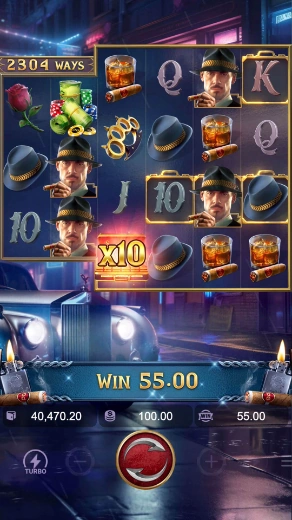
At the end of a main-game spin with one or more Wilds, each Wild may randomly transform into a Multiplier symbol with a value from ×2 to ×100. The word may matters. A main-game Wild is not a guarantee that the transformation occurs, and the maximum individual value is not an award automatically assigned to every Wild.
The picture shows a single ×10 sign on the grid and WIN 55.00 below. It is an end-of-spin multiplier state, not a statement that the next purchased spin costs ten times as much. The visible 55.00 is the amount being illustrated before the multiplier result in the following manufacturer frame.
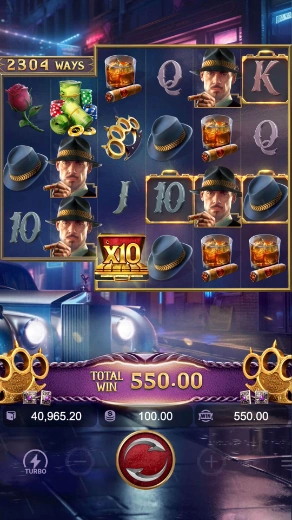
The completed example displays TOTAL WIN 550.00 while retaining the ×10 sign. The arithmetic is 55.00 × 10 = 550.00. This checks the numbers in that supplied example; it does not establish a net profit, since the total win and the original stake are different quantities.
A later falling-symbol round within one spin should not be confused with a new spin. The transformation point is the end of the spin, after the internal rounds have been resolved. Assigning a new random multiplier to every intermediate frame would add events that the stated rule does not describe.
Free spins: all Wilds transform at that end point

Three Scatters anywhere trigger 15 free spins. Every additional Scatter adds two more, and free spins can retrigger. The opening image states that all Wilds transform into ×2-to-×100 symbols. In context, that is the free-spins condition, rather than permission to replace the main game’s may randomly transform wording.
During free spins, all Wild symbols transform into Multiplier symbols at the end of the spin. This is a change to the transformation condition. It does not say that every resulting sign is ×100, that the same Wild stays through the whole free-spins feature, or that a symbol’s multiplier becomes a permanent collected account value.
| Question | Main-game rule | Free-spins rule |
|---|---|---|
| When is transformation considered? | End of the spin | End of the spin |
| Which Wilds transform? | Each may randomly transform | All Wild symbols transform |
| What values can a sign show? | ×2 to ×100 | ×2 to ×100 |
| What does sticky retain? | Wilds until the current spin ends | Wilds until the current spin ends |
| Does a Wild replace Scatter? | No | No |
The six-sign example explains the combined effect
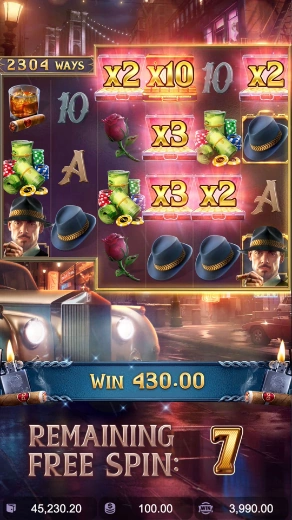
Read the six visible values in the free-spin example: ×2, ×10 and ×2 across the upper occupied positions, with ×3, ×3 and ×2 at the other multiplier positions. The cash Win is 430.00, and seven free spins remain. Seven is the counter for the feature, not a seventh multiplier sign.
The values add to 2 + 10 + 2 + 3 + 3 + 2 = 22. Keeping that sum visible makes it possible to compare the transformation frame with the supplied completed result, rather than assuming the signs multiply one another.
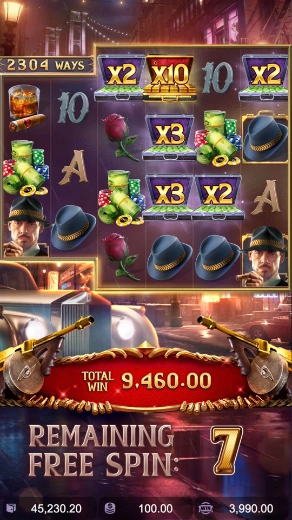
The corresponding manufacturer result is TOTAL WIN 9,460.00. The calculation 430.00 × 22 = 9,460.00 matches it. Multiplying all six signs together would give 720, which would not describe this illustrated result. This direct screen example resolves how the pictured signs combine without borrowing an additive rule from a different game.
The formal text describes applying the Multiplier symbols to the spin’s total win; the actual six-sign illustration supplies the concrete arithmetic here. It should not be stretched into an explanation of every animation update or a claim that all of the article’s other pictures are earlier moments in the same session. The main-game 55.00 example and the free-spin 430.00 example are separate illustrations.
A multiplier sign is not the maximum-win limit
The ×2-to-×100 range describes an individual Multiplier symbol. The specified maximum win is 10,000 times the bet amount, and the manufacturer states that reaching that total in the main game or free-spins feature ends the spin. An individual sign’s value, the sum of several signs and the maximum monetary result are three different measurements.
Nothing in a static Wild or multiplier picture predicts which symbols will appear next. The examples explain a documented transformation and calculation after their conditions are met; they do not establish that a future spin is due to transform, contain more Wilds or reach a limit.
Questions about the two transformation rules
Why does the opening say all Wilds when the main rule says may?
The illustrated opening is for free spins. The formal document separates the main sticky-Wild rule from the free-spins modification. Apply each statement within its stated mode instead of treating one promotional sentence as the rule for every spin.
Can a gold frame skip straight to a multiplier just by landing?
The documented route is conditional: a framed ordinary symbol involved in a win becomes Wild at the next falling-symbol round; the Wild then follows the end-of-spin transformation rule for the current mode. Presence of a frame alone is not that complete chain.
Source: PG SOFT, Mafia Mayhem English game information, version 1.0.r6, pages 3–10, retrieved 18 November 2026. Images are actual manufacturer example game screens. They do not establish current availability, account currency or an identical client build on Vegas11, and they are not an author’s play history.