
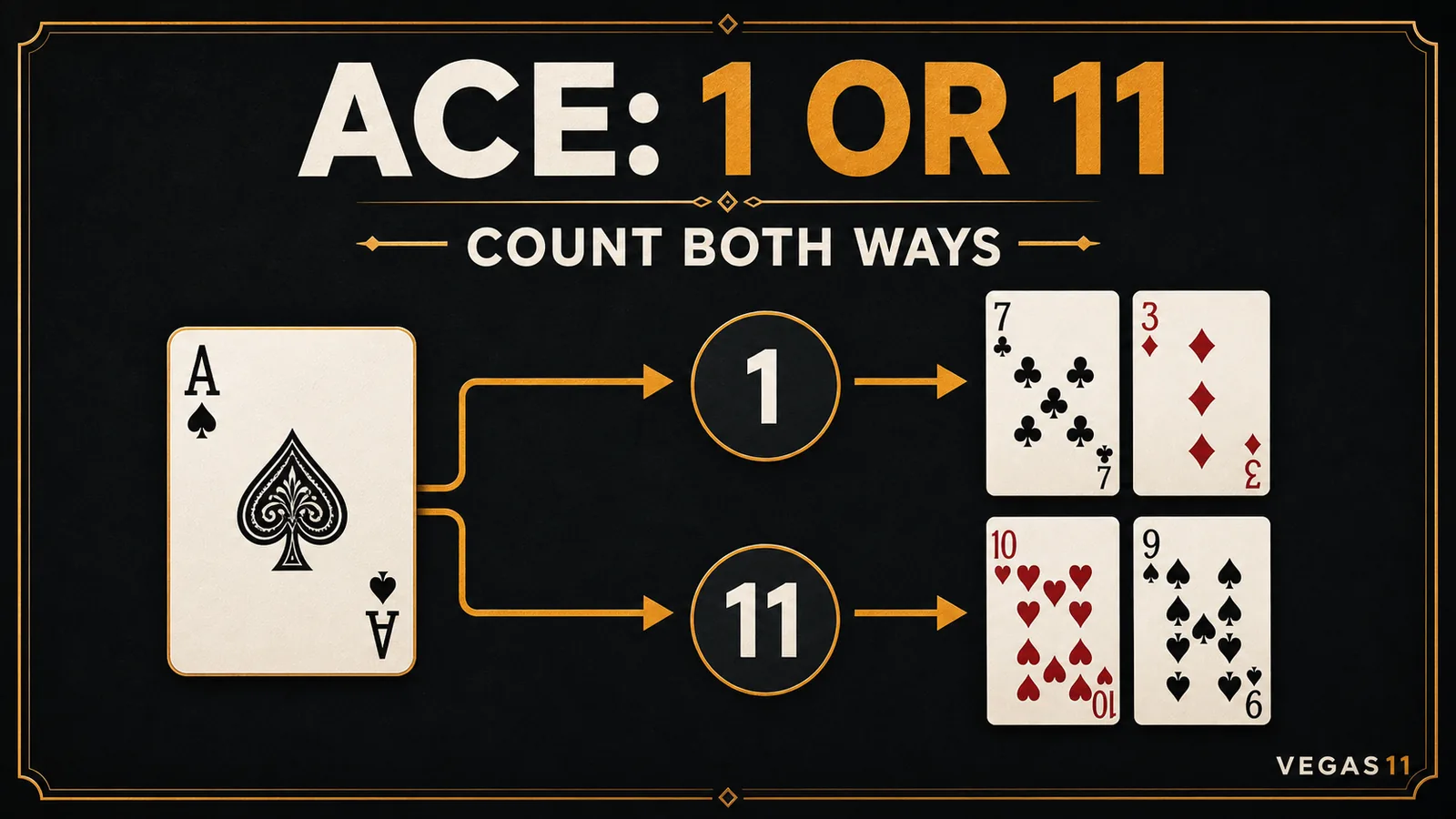
Quick answer: In blackjack, cards 2 through 10 count at face value, face cards count as 10, and an Ace can count as 1 or 11. The useful distinction is not just the total: a soft hand still has an Ace that can fall from 11 to 1, while a hard hand does not.
Written and checked by the Vegas11 Editorial Team. Rules reviewed July 27, 2026.
Blackjack involves financial risk. Adults 18+ only. Play only where permitted, set a money and time limit before joining, and stop when either limit is reached. Do not chase losses. No hand label predicts the next card.
Blackjack card values
| Card | Value | Example |
|---|---|---|
| 2–10 | Face value | 8 + 7 = 15 |
| Jack, Queen, King | 10 | Queen + 6 = 16 |
| Ace | 1 or 11 | Ace + 6 = soft 17 |
| Ace plus a ten-value card | Natural blackjack | Check the displayed payout |
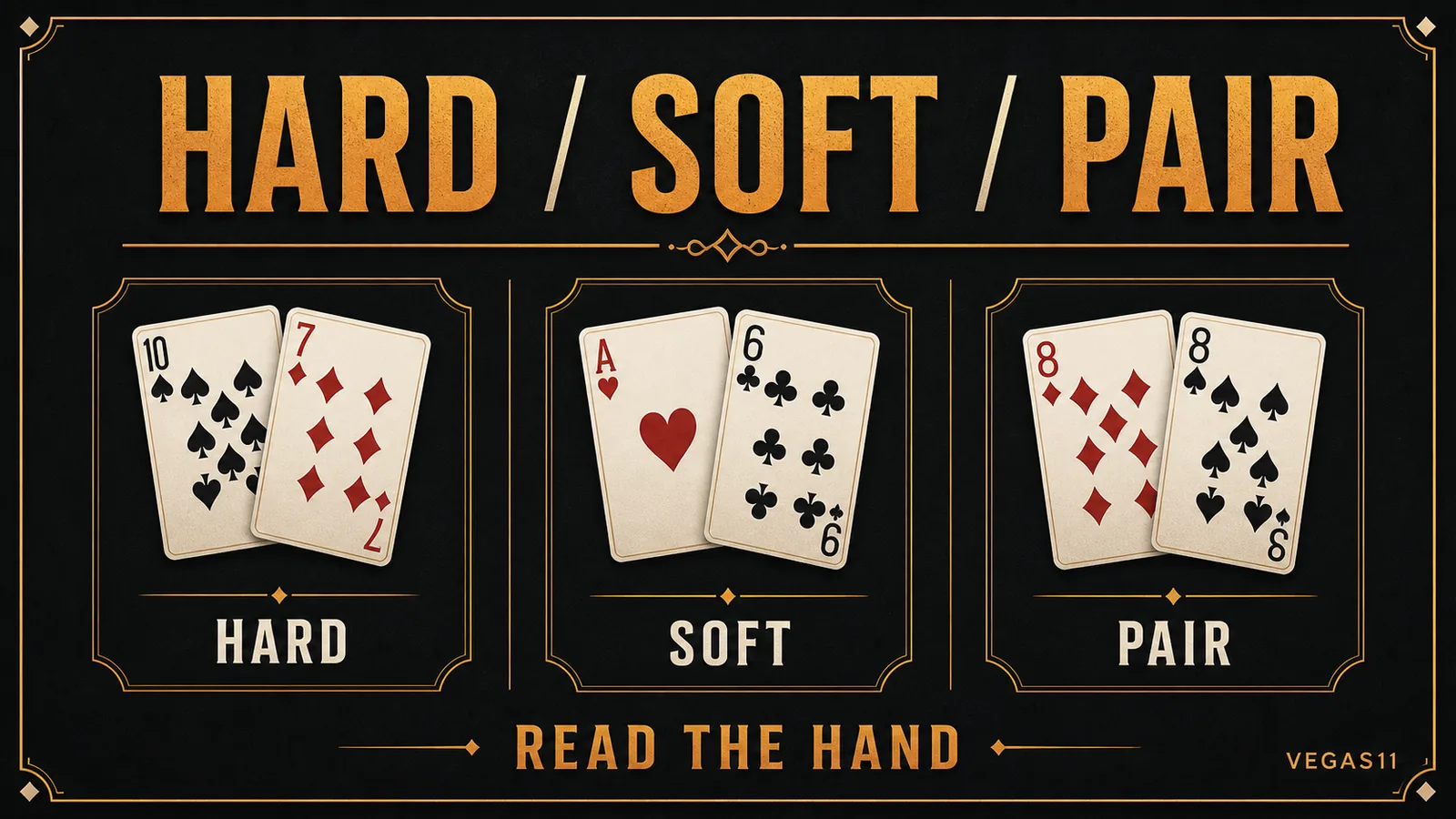
An Ace is counted as 11 when that keeps the hand at 21 or below; otherwise it counts as 1. That is why Ace-6 is soft 17, but 10-7 is hard 17. A two-card Ace plus a ten-value card is normally called a natural blackjack. Reaching 21 with three or more cards is not automatically the same result.
Hard hands, soft hands and pairs
| Hand type | What it means | Example |
|---|---|---|
| Hard total | No Ace can safely count as 11 | 10 + 7 = hard 17 |
| Soft total | An Ace is currently counting as 11 | Ace + 6 = soft 17 |
| Pair | Two cards may be eligible to split | 8 + 8 |
| Natural blackjack | First two cards total 21 | Ace + King |
A pair is a table-rule question as well as a hand label. Some games permit splitting identical ranks, while others may describe eligibility differently. Splitting creates a second hand and normally requires another stake equal to the first, so include that possibility in the limit set before play.
Read the available actions and payout before making a decision. The table-game overview gives context for card and wheel games; the site’s first-time blackjack rules guide is a separate introduction. The table’s own rule screen controls the hand in front of you.
A practical pre-hand check
- Count the hand once, including whether the Ace is currently 11.
- Read the dealer rule, payout, and split limits on that exact table.
- Check whether a double or split could add another equal stake.
- Pause if the rule screen is unclear or the decision timer feels rushed.
Previous cards do not change the value of the cards already in your hand, and they do not guarantee what arrives next. If the controls or terms are unclear, use Vegas11 support before committing a stake.
Frequently asked questions
Is Ace-6 a hard or soft 17?
It is soft 17 because the Ace can count as 11 without taking the total above 21.
Is every 21 a blackjack?
No. A natural blackjack normally means an Ace and a ten-value card among the first two cards. Other totals of 21 may settle as ordinary wins under the table rules.
What does a hard hand mean?
A hard hand has no Ace that can still count as 11 without making the total exceed 21.
Does a pair always allow a split?
No. Read the table rules. Split eligibility, re-splits, and rules for split Aces can vary.
Why should I check the payout before a hand?
The displayed payout determines how a natural blackjack is settled. It should be read alongside the dealer and action rules.
Source and update note
Rules checked July 27, 2026 against Bicycle Cards blackjack rules, the Nevada Gaming Control Board blackjack rules, and UK Gambling Commission guidance on time and money limits. The in-game rule screen is the controlling source for a specific table.