
Quick answer: Online blackjack is a game against the dealer. Your aim is to finish closer to 21 than the dealer without going over. Before using any decision chart, check the table’s blackjack payout, dealer soft-17 rule, doubling limits, splitting limits, and minimum stake. Those details affect the return and which player actions fit the game.
Written and checked by the Vegas11 Editorial Team. Rules reviewed on July 14, 2026.
Blackjack involves financial risk. Play only if you are an adult where the game is permitted, choose money you can afford to lose, and stop when your money or time limit is reached. A sound decision cannot predict the next card.
This guide is published by Vegas11 and explains the rules and their limits without promising a result.
How an Online Blackjack Round Works
You play one or more hands against the dealer, not against the other players. A common online table gives you two cards and shows at least one dealer card. Some games give the dealer a hidden second card immediately; others deal that card later. The rule screen should explain the procedure.
Your hand wins when it remains at 21 or below and finishes higher than the dealer, or when the dealer goes over 21 while your hand remains active. If your cards exceed 21, the hand busts and the main stake is lost even if the dealer later busts.
The Vegas11 table-game overview places blackjack alongside other card and wheel games. The important difference is that blackjack gives the player several decisions after the first deal, while the dealer follows a fixed drawing rule.
Blackjack Card Values
Add the cards using the values below. An Ace changes between 11 and 1 when counting it as 11 would push the hand over 21. A hand such as Ace-6 is a soft 17 because the Ace can still fall back to 1; a hand such as 10-7 is a hard 17.
| Card | Value | First-time player note |
|---|---|---|
| 2 through 10 | Face value | A 7 counts as 7. |
| Jack, Queen, King | 10 | All four ten-value ranks are counted the same. |
| Ace | 1 or 11 | Use 11 unless that would make the hand exceed 21. |
| Ace + ten-value card as the first two cards | Natural blackjack | This may receive the table’s special blackjack payout. |
A two-card Ace and ten-value card is a natural blackjack. That is different from reaching 21 with three or more cards. A 21 made after splitting Aces may also be treated as an ordinary 21, so do not assume it receives the natural-blackjack payout.
The Order of Play
- Read the table details. Confirm the bet range and the rules shown for that game.
- Place the initial stake. The amount must fit the limit you set before opening the table.
- Receive the opening cards. Read your total and the dealer’s exposed card.
- Choose an available action. Hit, stand, double, or split may appear; surrender and insurance are offered only under certain conditions.
- Let the dealer complete the hand. The dealer draws or stands according to the displayed rule, then the game settles active hands.
Do not begin a hand if the decision timer feels too short for careful choices.
Hit, Stand, Double and Split
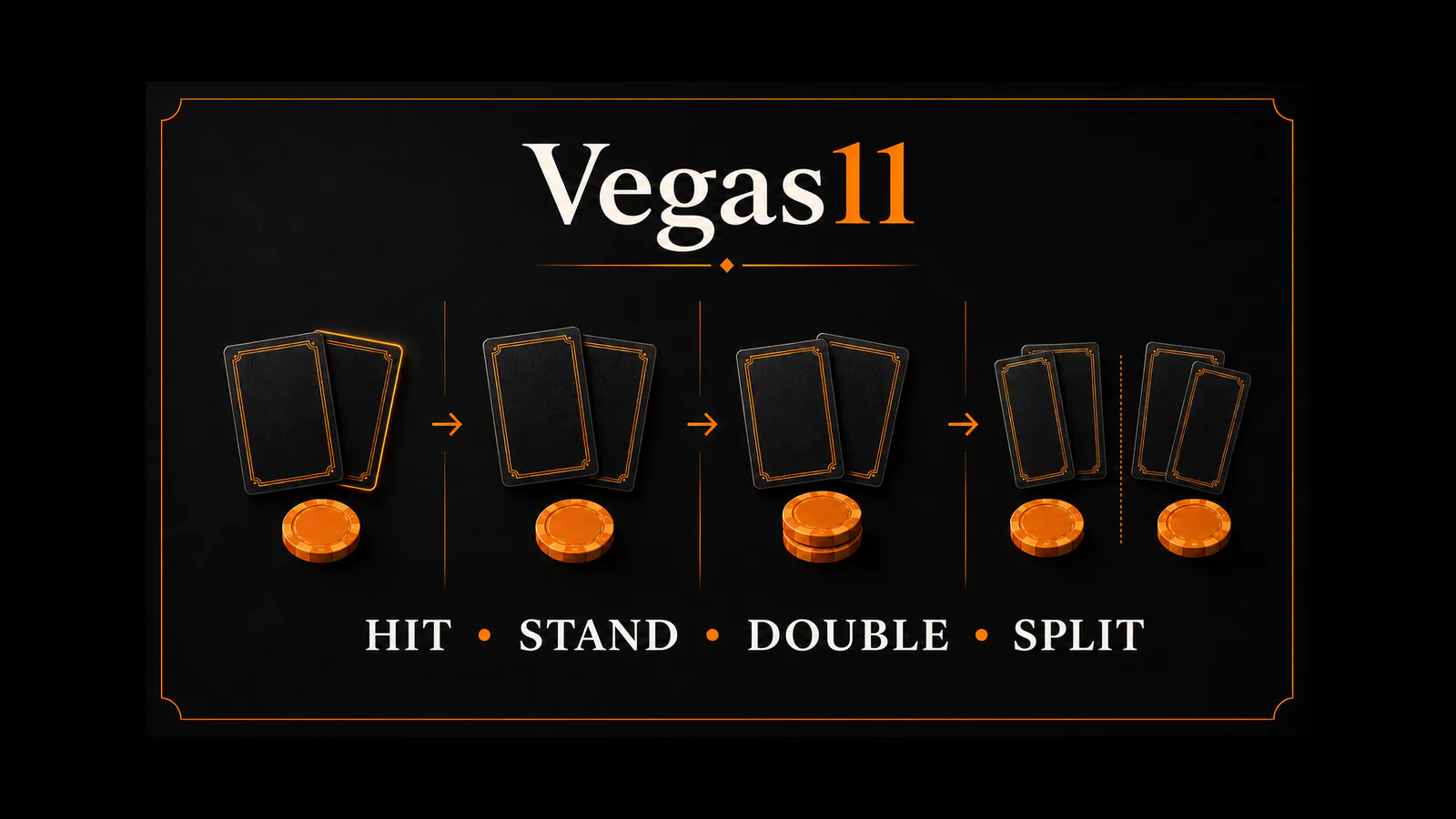
Hit means take another card. You can usually hit again while the hand remains below 21, unless a special rule ends the action.
Stand means keep the current total and end your decisions for that hand. The dealer will later compare totals if your hand has not busted.
Double normally means add an amount equal to the initial stake, receive exactly one more card, and then stand. Tables may restrict doubling to certain opening totals, and some do not allow doubling after a split.
Split turns an eligible pair into two separate hands. You add a second stake equal to the first, then play each hand under the table’s split rules. Check whether the game allows equal-value cards, matching ranks only, re-splitting, double after split, or more than one card on split Aces.
Insurance is separate from those four actions. When the dealer shows an Ace, a table may offer an insurance side bet of up to half the main stake. A common rule pays insurance at 2:1 if the dealer has blackjack. If the dealer does not, the insurance stake is lost and the main hand continues. Treat it as a separate wager, not as a change to your cards.
Four Table Rules to Check First
A decision chart only fits the rule set for which it was made. Use this table before relying on one.
| Check | What to read | Why it matters |
|---|---|---|
| Blackjack payout | 3:2, 6:5, or another displayed return | The same natural can pay a different amount. |
| Dealer rule | Stands on soft 17 (S17) or hits soft 17 (H17) | The dealer’s required action changes the rule model behind a chart. |
| Doubling | Allowed totals and double-after-split rule | A chart may recommend an action the table does not offer. |
| Splitting | Eligible pairs, re-splits, and split-Ace limits | One opening pair can create different options and a larger total stake. |
Also confirm the minimum and maximum stake. A low opening minimum does not mean every decision costs that amount: doubling or splitting can add another equal stake. If the game information is unclear, pause and contact Vegas11 support rather than filling the gap with a guess.
Why 3:2 and 6:5 Are Not the Same
Payout notation describes profit relative to the initial stake. With a 100-unit stake, a 3:2 blackjack pays 150 units of profit; the original 100-unit stake is also returned. A 6:5 blackjack pays 120 units of profit, plus the original stake. The difference is 30 units on the same natural blackjack.
That comparison does not predict how often blackjack will appear. It simply shows why the payout line deserves attention before the first hand. Ordinary winning hands are commonly paid 1:1, while a tie usually returns the main stake, but the table screen remains the controlling source.
Use the Read–Match–Fund–Decide Check
Read: Open the rule screen and paytable. Find the payout, dealer rule, action restrictions, and bet range.
Match: Use only a decision chart that names the same rule set. A chart for S17 should not be treated as interchangeable with H17, and a chart that assumes double after split may not fit a table that blocks it. If the chart specifies deck count or surrender, those details must match too.
Fund: Set one affordable money limit and one time limit before play. Include the possibility of an extra equal stake for double or split. Do not raise either limit because a previous hand lost.
Decide: Join only when the rules are readable and the available actions fit your plan. Stop when either limit is reached, when decisions begin to feel rushed, or when you are trying to recover a prior loss.
Common First-Hand Mistakes
- Calling every total of 21 a blackjack. The special term normally applies to the first two cards.
- Opening a chart without checking its S17/H17 and action assumptions.
- Planning only for the first stake, then doubling or splitting without room in the session amount.
- Reading insurance as protection for the main hand. It is a separate wager with a separate result.
- Changing stakes in response to a short run of cards. Previous hands do not tell you which card comes next.
Frequently Asked Questions
Is 21 always a blackjack?
No. A blackjack normally means an Ace and a ten-value card as the first two cards. A total of 21 made with three or more cards, or after a split, may be settled as an ordinary winning hand under the table rules.
Does the dealer always stand on 17?
Not under every rule set. Many tables require the dealer to stand on hard 17, but a soft 17 may be a stand or a hit. Check whether the table displays S17 or H17 before using a decision chart.
What happens when I double down?
You normally add an amount equal to the opening stake, receive one final card, and then stand. The totals eligible for doubling and whether you can double after splitting depend on the table.
Can a basic strategy chart predict the next hand?
No. A chart identifies a decision for a defined set of rules and card information; it does not know the next card or promise the result of one hand. Match the chart to the table and keep the money limit unchanged.
What should I check before joining an online blackjack table?
Check the blackjack payout, dealer soft-17 rule, doubling and splitting restrictions, minimum and maximum stake, and any decision timer. Join only when those details are clear and the possible extra stake fits your session limit.
Source and Update Note
Rules were checked on July 14, 2026 against the Bicycle Cards blackjack rules, the Nevada Gaming Control Board live blackjack rules, PlayWell’s blackjack guide, and the UK Gambling Commission’s player guidance on money and time limits. Online versions and table terms can change. The rule screen inside the game should be checked again before play.