
Wild Bounty Showdown starts every free spin at ×8. A qualifying winning round then doubles the multiplier after its wins are paid and new symbols have fallen. That can produce ×8, ×16, ×32 and later values within one free spin. It is not a multiplier bank that automatically carries the previous free spin’s ending value into the next one.
The actual English game screens below show the current multiplier arc, gold-frame conversion and two free-spin states with the same remaining counter. The key is to distinguish a new falling-symbol round from a newly started free spin.
Read the large centre value in the multiplier arc
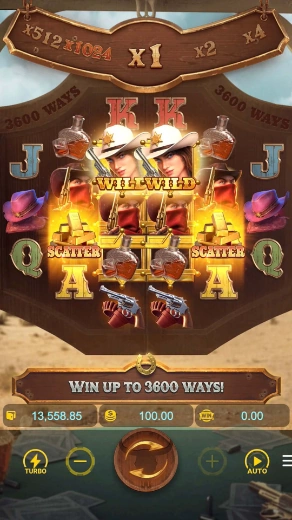
The western-themed grid has six reels: three rows on the outer two, four rows on the next pair and five rows on the middle pair. The document specifies 3,600 ways. Above the grid is a curved multiplier display with a large central value and smaller neighbouring values.
In the supplied main-game state, ×1 is in the centre. The other labels around the arc are not separate multiplier symbols to add or multiply together. Read the current central value when following the round’s multiplier, rather than treating every number printed on the sign as an award already activated.
Cowgirl pictures labelled WILD and gold-bar Scatters have different functions. Wild substitutes for eligible symbols except Scatter. The gold-framed ordinary symbols used by the transformation feature appear only on reels three and four. That statement about gold frames should not be expanded into an unsupported rule about every possible Wild’s location.
Gold frames need their own qualifying win
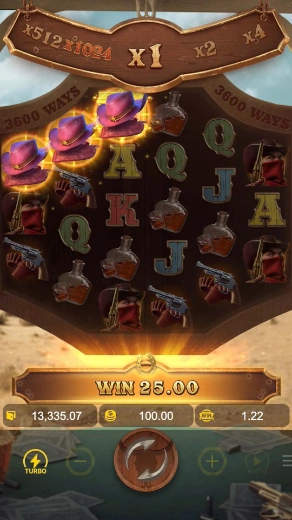
The transformation example highlights three pink hats, one of which has a gold frame in the central area. A qualifying gold-framed symbol involved in the previous round’s win transforms into Wild at the next round after new symbols have fallen. Merely seeing a gold border is not the entire condition.
The frame rule excludes Wild and Scatter from the eligible ordinary symbols that can receive those gold frames. It is not a way to create extra Scatters by changing a Wild, or a statement that every highlighted hat anywhere on the board becomes Wild.
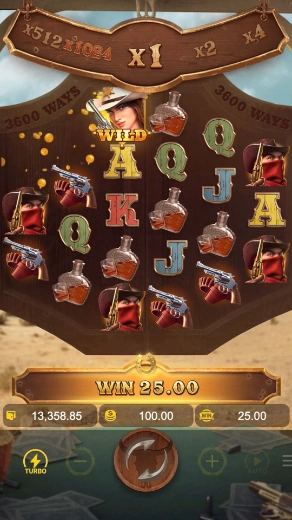
The following supplied conversion illustration shows a cowgirl WILD at the framed-hat position while ordinary pictures remain elsewhere. It demonstrates a position-specific conversion, not an unconditional whole-board transformation. The still image does not establish the exact refresh timing of every other animated field on the screen.
This frame conversion and the multiplier update have different conditions. Gold conversion follows the qualifying framed symbol’s previous win. Multiplier doubling follows a qualifying winning round. A round can involve both without making one rule a substitute for the other.
Main-game doubling begins at ×1
At the start of a main-game spin, the multiplier is ×1. If the round has one or more winning symbols, the wins are paid, new symbols fall and the multiplier doubles. The increase therefore applies to the following round rather than retroactively making every already paid earlier round use the latest value.
One or more winning symbols is a condition for the update, not a separate doubling for each symbol in the combination. A round with several highlighted symbols does not, simply because there are several, apply the same update repeatedly before the next falling-symbol round.
A simple rule-based sequence is ×1, then ×2, then ×4, then ×8 under successive qualifying round transitions. This is actual doubling. It is not an additive ladder of one, two, three, four, and it should not be replaced with a fixed plus-two rule borrowed from another game.
| Round in a continuing winning sequence | Main-game starting sequence | Free-spin starting sequence |
|---|---|---|
| First | ×1 | ×8 |
| Second after a qualifying win | ×2 | ×16 |
| Third after another qualifying win | ×4 | ×32 |
| Fourth after another qualifying win | ×8 | ×64 |
The table illustrates the qualifying progression, not a promise that a spin reaches four rounds. If there is no further winning combination, the existence of a later value on the arc does not make that stage occur.
Every free spin starts at ×8

Three Scatters anywhere trigger ten free spins. Each additional Scatter adds two more, and free spins can retrigger. The opening screen explicitly states that every free spin starts with ×8 and that the multiplier doubles after each qualifying win.
The word every supplies the boundary. Starting the next free spin is not the same event as moving to the next falling-symbol round inside the current one. Within a free spin, qualifying wins can grow the current multiplier. At a new free spin’s start, the documented starting value is ×8.
For a hypothetical example, suppose one free spin reaches ×32 during its internal chain. The next free spin begins at the stated ×8; the rule does not say it starts at ×32 or automatically doubles that prior ending value to ×64. Those hypothetical states explain the boundary rather than reconstructing a particular supplied cash result.
Two pictures can keep nine remaining while the multiplier changes
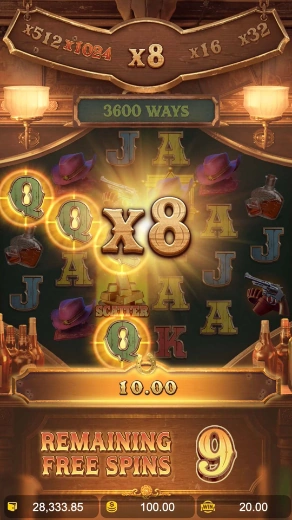
The first free-spin illustration displays ×8 prominently and nine remaining free spins. Eight is the current multiplier; nine is a feature counter. They are not factors to multiply together as though the counter were an additional multiplier.
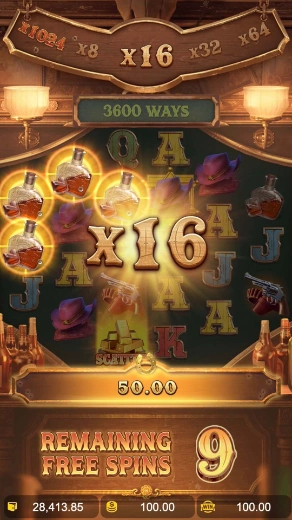
The next illustration displays ×16 while the remaining counter is still nine. Falling-symbol rounds can progress inside a free spin without each round consuming another item from that counter. The unchanged counter is therefore not enough evidence that the multiplier failed to update correctly.
A hypothetical underlying win of 10 in a round that uses ×16 would become 160 under that multiplier. This invented amount is separate from the cash animation shown in the picture. The article does not infer an unpictured final balance or a complete history of every consumed and retriggered free spin.
The multiplier ceiling and maximum win are different limits
The document specifies a maximum win multiplier of ×1,024. That is a limit on the feature’s multiplier value. Its maximum-win section separately lists a maximum amount of 5,000 times the bet. The two figures refer to different quantities: a multiplier applied to a qualifying win and a monetary-result limit relative to the stake.
A smaller neighbouring ×1,024 label in the arc is not proof that the currently centred value is already 1,024. Nor does reaching a multiplier value by itself establish the size of an underlying winning combination. Do not replace either calculation with a promise of a maximum result.
The cited maximum-win section states the amount. This article does not import another title’s additional stop or settlement wording where the supplied section does not state it. The current game’s rules, rather than a similar-looking cowboy theme, determine those details.
Questions about the reset and transformation
Does every highlighted symbol double the multiplier separately?
The rule checks whether a round has one or more winning symbols, then doubles after payment and falling replacements. It is a qualifying round transition, not a loop that doubles once for every highlighted picture.
Do ordinary gold frames add free spins?
Their documented role is conversion to Wild after the stated winning condition. Scatter symbols trigger or retrigger the free-spins feature. Do not treat a gold-framed ordinary symbol as another Scatter merely because both are visually prominent.
Source: PG SOFT, Wild Bounty Showdown English game information, version 1.0.r3, pages 3–9, retrieved 18 November 2026. Images are actual manufacturer example game screens. They do not establish current availability or identical settings on Vegas11, and they are not an author’s continuous play record.