
In the main game of Wild Ape #3258, two consecutive winning rounds unlock the large central ape. A win in round one unlocks the first padlock; a win in round two unlocks the second, and the Wild Bored Ape activates in round three. These are falling-symbol rounds within one spin, not two wins accumulated across separate purchased spins.
Ordinary Wild ape signs can already appear while the large portrait remains chained. The real English screens below show how to distinguish those ordinary Wilds from the central feature, and why an active ×8 is part of a two-at-a-time increase rather than a repeated doubling rule.
Two ordinary Wilds do not mean the large ape is unlocked
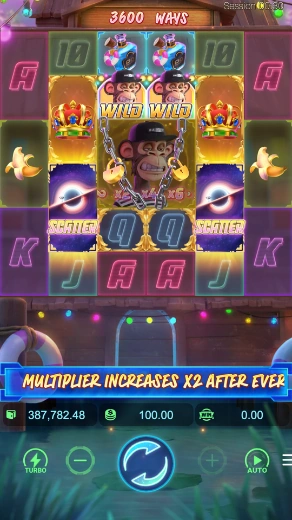
The six-reel game places its large Wild Bored Ape across the middle area in reels three and four. At the start of a main-game spin it is inactive, held by two chained padlocks. In the manufacturer picture, separate ordinary Wild ape signs are visible elsewhere while the large central face is still behind the chains.
This gives two different questions to ask of the picture: is an ordinary Wild available for symbol substitution, and has the large locked feature activated? Counting every ape picture as if it were the same object would answer neither question correctly.
The number above the grid is a ways count. The illustrated state shows 3,600 ways, within the document’s specified range of 256 to 32,400. It is not the large ape’s current multiplier, an account value, or a count of padlocks left to open.
Follow winning rounds, not separate spin buttons
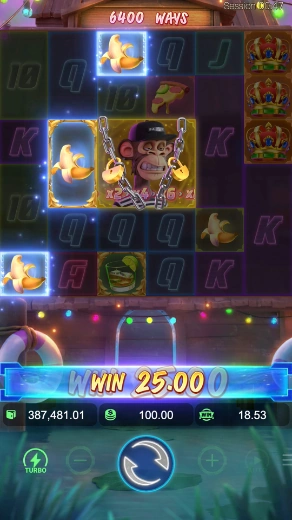
The first win unlocks one padlock. A second winning round in the same spin unlocks the other, with the central Wild Bored Ape becoming active in the third round. The condition is consecutive winning rounds in that falling-symbol sequence. A win now and another win in a later independent main-game spin are not a stored pair of keys.
At the start of each main-game spin, the large ape is set inactive with two chained padlocks. That boundary prevents treating a partly opened picture as a permanent account-level achievement that must continue indefinitely across later spins.
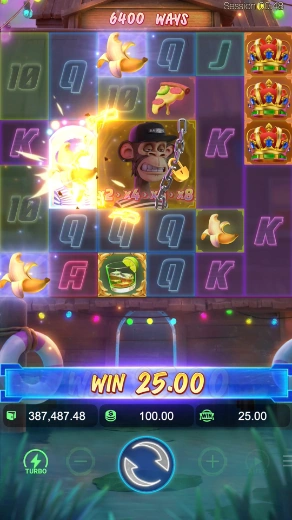
The supplied unlocking frame shows a bright chain-and-padlock animation beside the portrait. It helps identify the feature event, but it does not show a complete record of every preceding payment. The written first-round, second-round and third-round conditions are the reference for its timing.
| Main-game point | Documented feature state |
|---|---|
| Start of the spin | Large ape inactive; two chained padlocks |
| Win in round one | First padlock unlocks |
| Win in round two | Second padlock unlocks |
| Third round | Wild Bored Ape activates |
| Later winning rounds after activation | Win multiplier increases by two |
The locked portrait may already have small printed multiplier information near it. Do not use those printed values alone as proof that the feature is active. The chains, padlocks and actual activated badge supply more useful context than finding the number two anywhere around the portrait.
Activation starts the multiplier at ×2
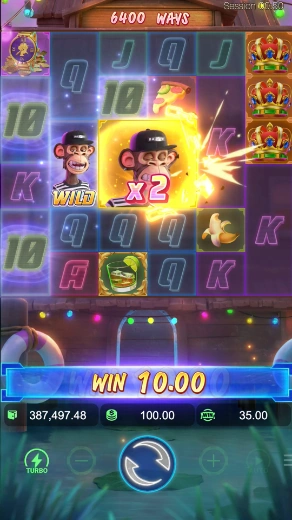
When the Wild Bored Ape activates, the win multiplier is ×2. The unchained illustration displays that value prominently on the central ape. The large symbol substitutes for eligible symbols except Scatter; it does not supply an extra Scatter for the free-spins trigger.
After activation, the multiplier increases by two after wins in subsequent rounds. The increment is a fixed addition of two, rather than multiplying the existing value by two. A multiplier series can therefore pass through ×2, ×4, ×6 and ×8 under successive qualifying updates.
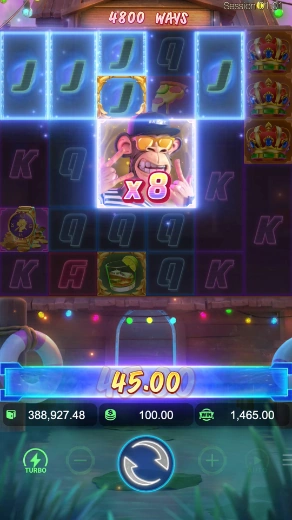
The later illustration shows ×8 on the ape while J symbols glow. A change from ×4 to the next value under a plus-two rule would be ×6, not ×8. This is the clearest distinction between adding two and repeatedly doubling, even though the first ×2-to-×4 change happens to fit both operations.
For a hypothetical round with a confirmed multiplier of six and an underlying win of 10, the multiplier calculation gives 10 × 6 = 60. The invented amount explains the operation. It is not a reconstruction of the cash animations in the supplied ×2 and ×8 pictures, and it does not say that the presence of any ape picture guarantees a win.
Gold-frame Wild conversion is another route
The ordinary Wilds have their own source. Eligible ordinary symbols occupying one to three spaces on reels two to five may have gold frames. A gold-framed symbol involved in a win transforms to Wild in the next round after new symbols have fallen.
That conversion is different from removing the two locks on the central ape. A gold-frame win can explain an ordinary Wild elsewhere in the grid while the large feature is still locked. It should not be counted as automatically removing both padlocks or immediately activating the central portrait.
Ordinary Wilds also substitute for eligible symbols except Scatter and appear on reels two to five. Keeping those exclusions visible prevents a row containing a normal Wild and Scatters from being counted as an extra Scatter merely because the symbols all look special.
A free spin starts with the large ape active
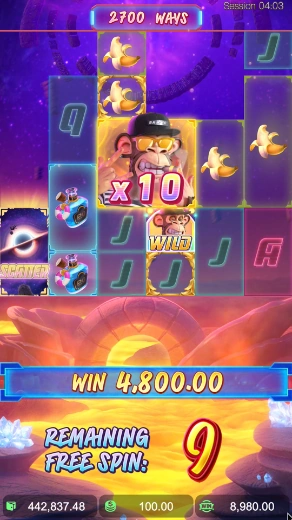
Four Scatters anywhere trigger ten free spins, with two additional free spins for every extra Scatter. Free spins can retrigger. The free-spin rule starts with the Wild Bored Ape active at ×2, then increases the multiplier by two after wins in subsequent rounds. It does not ask the reader to apply the main game’s two-lock opening condition before the ape can function in that free spin.
The example shows an ape multiplier of ×10 with nine free spins remaining. Ten here is a multiplier badge, whereas nine is the current counter. A feature initially awarding ten spins does not mean that every later multiplier badge reading ten is another ten-spin award.

Another example shows ×20 and eight remaining free spins. It demonstrates a higher multiplier state, not an instruction to double the previous picture’s ×10 because the counter changed from nine to eight. The formal update condition is winning rounds and an increase of two, not “double at the next completed free spin.”
The pictures are separate manufacturer states. They do not by themselves establish every intervening cascade, retrigger or start-of-free-spin update. Do not turn the sequence of illustrations into an invented uninterrupted play history or a permanently retained multiplier bank that the cited rule does not describe.
A multiplier badge is not the maximum cash award
The specified maximum win is 10,000 times the bet amount. That describes a result limit relative to the stake, rather than a claim that the large ape always reaches ×10,000 or that a visible ×20 badge represents twenty currency units. The document’s maximum-win section should not be replaced with a limit rule borrowed from another title.
Likewise, the game title’s number 3258 is part of its name. It is not the current ways count, a multiplier to include in a result calculation, or an investment price. The documented mechanics here are a game feature involving locks, substitution and winning-round updates.
Quick questions about the central ape
Do two ordinary Wild symbols remove the two locks?
The unlock condition is winning rounds one and two, followed by activation in round three. The number of ordinary Wild signs visible on the grid is not a substitute for that sequence.
Does an active ape make the next round certain to win?
It has a documented substitution role and multiplier feature. Those describe how a qualifying result is evaluated, rather than a guarantee about the next falling symbols or a prediction that the chain will continue.
Source: PG SOFT, Wild Ape #3258 English game information, version 1.0.r4, pages 3–9, retrieved 18 November 2026. Images are actual manufacturer example game screens. They do not establish current availability or identical settings on Vegas11, and they are not an author’s continuous play record.