
Tsar Treasures opens its coloured Treasure Eggs at different rounds in the main game and free spins. In the main game, red, green and blue eggs convert to Wilds from rounds three, five and seven respectively. In free spins, the matching thresholds are rounds two, three and four. The round is a falling-symbol round within the current spin, not a count of separate free spins used.
That difference also changes the multiplier ladder. The main game reaches ×15 in the seventh round, while free spins reach it in the fourth. The actual English pictures below let you compare the stage strip, coloured eggs and remaining-spin counter without treating them as the same kind of progress.
The three eggs belong to a stage display
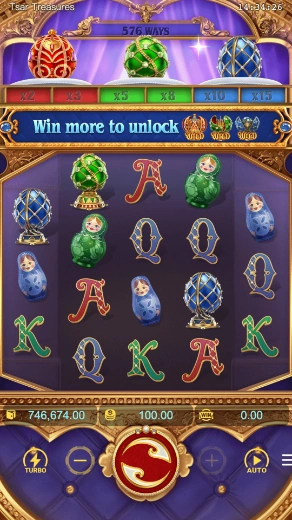
The game has five reels, with three rows on the first and fifth and four rows on the middle three. It uses 576 ways. Above the grid sit red, green and blue egg indicators. Immediately below them is a strip containing ×2, ×3, ×5, ×8, ×10 and ×15.
The ordinary grid also contains Treasure Egg symbols and nesting-doll pictures. The coloured eggs are connected to the stage conversion feature. The Scatter is separately labelled and has the free-spins trigger role. A red Treasure Egg is not automatically a Scatter just because it looks valuable, and the three coloured indicators are not a count saying that three free spins have been awarded.
Wild substitutes for eligible symbols except Scatter. The role of a transformed egg is therefore substitution in qualifying combinations; it is not an extra Scatter toward entry. Begin by locating the current mode and the highlighted stage before interpreting a particular egg picture.
Main game: red at round three, green at five, blue at seven
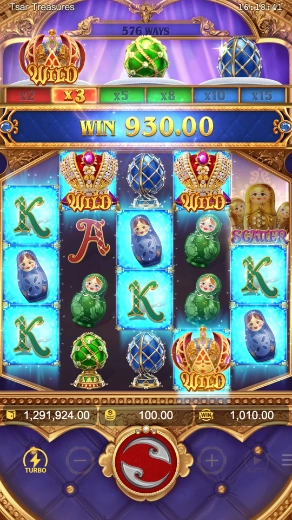
The main-game ladder applies ×2 to wins in the second round, ×3 in the third, ×5 in the fourth, ×8 in the fifth, ×10 in the sixth and ×15 in the seventh and later rounds. The steps are not a simple increase of one each time.
At the third round and beyond, all red Treasure Egg symbols transform into Wilds. The illustrated ×3 state has the red indicator open and red-crowned Wilds visible. The colour and the active multiplier describe the same stage of this main-game example, rather than a new free-spin award.
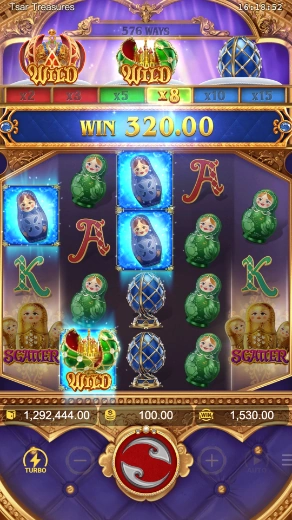
Green Treasure Eggs convert from the fifth round onward. The ×8 example shows the red and green indicators open, while the blue indicator remains closed. Its place on the ladder follows the documented main-game sequence; green is not waiting for the fifth separately purchased spin.
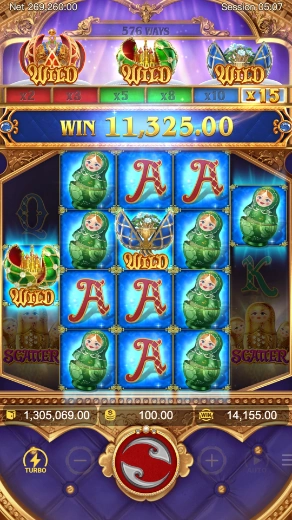
Blue Treasure Eggs convert from the seventh round onward. The ×15 picture shows all three indicators open, with green- and blue-crowned Wilds visible on the grid. Reaching this stage does not mean every ordinary picture becomes Wild: the conversion condition applies to the corresponding Treasure Egg symbols.
This is also different from a gold-frame feature that requires a framed picture to have won first. The Treasure Egg rule says all eggs of the qualifying colour transform from their stated round onward. Do not add an unstated requirement that each individual egg must first supply a separate winning combination.
Free spins compress both the ladder and egg thresholds
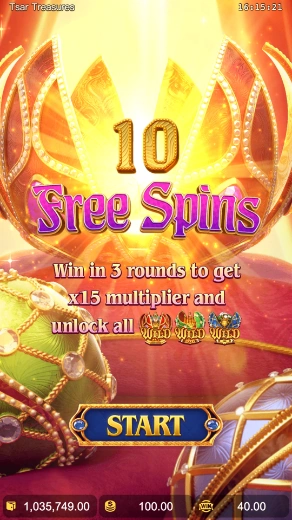
Three Scatters anywhere trigger ten free spins, with two extra spins for every additional Scatter. Free spins can retrigger. Once inside that mode, the later-round rules change: second-round wins use ×3, third-round wins use ×8, and fourth-round and later wins use ×15.
The coloured eggs move earlier too. Red eggs convert from the second round, green from the third and blue from the fourth. The free-spins opening says to win in three rounds to get ×15 and unlock all egg types. Read that as the chain reaching its fourth evaluation round after three winning rounds, rather than a promise attached to the fourth separate free spin.
| Mode and round | Win multiplier at the listed stage | Egg conversion available from this stage |
|---|---|---|
| Main round 2 | ×2 | No colour threshold listed yet |
| Main round 3 | ×3 | Red |
| Main round 4 | ×5 | Red continues |
| Main round 5 | ×8 | Green joins red |
| Main round 6 | ×10 | Red and green continue |
| Main round 7 and later | ×15 | Blue joins red and green |
| Free-spin round 2 | ×3 | Red |
| Free-spin round 3 | ×8 | Green joins red |
| Free-spin round 4 and later | ×15 | Blue joins red and green |
The table compares the documented later-round stages. It is not a sequence of guaranteed outcomes. A spin may stop without reaching a later falling-symbol round, and a threshold does not force every colour of egg to appear. It tells you what happens to a qualifying colour if the relevant stage and symbols occur.
Two identical underlying amounts can use different multipliers
Consider a hypothetical underlying win of 10 in the second round. Under the main-game second-round rule it becomes 10 × 2 = 20. In the second round of a free spin, the stated multiplier is ×3, so the corresponding calculation is 10 × 3 = 30. The mode changes the applicable rule even when the round number and invented underlying amount are the same.
Now compare the fourth round: main-game wins at that stage use ×5, while fourth-round free-spin wins use ×15. This is why “round four” on its own is incomplete information. You need both the mode and the current falling-symbol round before choosing a ladder value or an egg threshold.
These examples describe each round’s applicable multiplier. They do not take the total of all earlier already evaluated rounds and repeatedly multiply it again by every later step. Nor do they describe increasing a stake to reach a stage; the figures are rule-reading examples, not instructions for changing a bet.
The lower fifteen counts free spins, not the stage
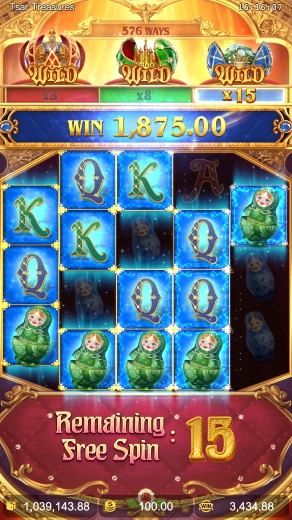
The official free-spin image has ×15 highlighted near the top and fifteen remaining free spins near the bottom. They happen to share the number fifteen but mean different things. The upper value is the win multiplier for the current free-spin stage; the lower value is how many free spins the feature currently has left.
All three egg indicators are open in that illustrated state. This fits the free-spin fourth-and-later-round rule. It does not establish that the feature has already consumed fifteen free spins, or that having fifteen remaining automatically unlocks every egg. The opening count, retriggered awards and current remaining counter are separate from the internal round threshold.
The main-game and free-spin pictures are manufacturer examples of different states. The article does not present them as an uninterrupted session, infer every missing retrigger, or use their different cash figures to invent an author’s balance history. Their value here is the visible correspondence between mode, stage and coloured egg indicators.
Keep the maximum-win limit separate
The document specifies a maximum win of 2,500 times the bet amount and states that reaching it in the main game or free-spins feature ends the spin. That is a monetary-result limit expressed relative to the stake. It is not the ×15 stage multiplier, the 576-ways display or the number of free spins remaining.
A screen explaining the stage cannot predict when a later stage will occur. The threshold rules describe a qualifying past or current state; they do not establish that a particular coloured egg is due to arrive, or that a long previous chain makes the next spin more likely to reach ×15.
Quick questions about egg timing
Does green require five free spins to be completed?
No. Five is the main-game falling-symbol-round threshold for green. In free spins the green threshold is the third round within a free spin. Neither statement counts completed free spins across the feature.
Do the three colours all unlock at once in the main game?
They have different starting thresholds: red at three, green at five and blue at seven. Later main-game rounds retain the earlier colours’ conversion conditions. Free spins use the earlier two-three-four thresholds instead.
Source: PG SOFT, Tsar Treasures English game information, version 1.0.r3, pages 3–10, retrieved 18 November 2026. Images are actual manufacturer example game screens. They do not establish current availability or identical settings on Vegas11, and they are not an author’s continuous play record.