
In Anubis Wrath, a number above a reel does not apply just because you can see it. An Anubis symbol on that reel activates the corresponding multiplier window. At the end of the spin, the game adds the activated values and uses that sum to multiply the spin’s total win. It does not multiply all five displayed values together.
Free spins add a second piece of information: collected multipliers stay for the rest of that free-spins feature. The English manufacturer screenshots below show where to look, which symbol does the activating, and why a large collected value is different from a single top-window value.
Start with the five windows above the reels
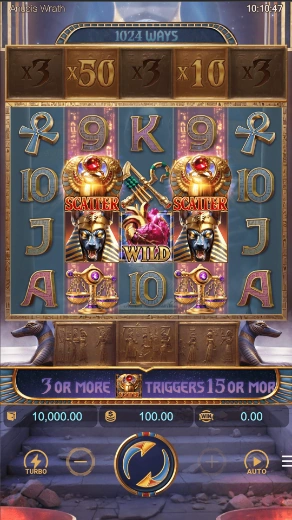
The main game is a five-reel, four-row arrangement with 1,024 ways. Above it sits a separate row of five multiplier windows. Their horizontal positions matter: each window corresponds to the reel underneath it. In the pictured main-game state, the row contains ×3, ×50, ×3, ×10 and ×3. Seeing all five numbers is not the same as activating all five.
The manufacturer specifies values from ×3 to ×500 at the start of a spin. These are available multiplier values for the feature, rather than amounts paid merely for opening the game. The row is also separate from the ways count above it. “1024 WAYS” describes the win-evaluation format; it is not another multiplier to include in the calculation.
Look at the symbols inside the main grid as well. The gold-and-black jackal heads are the Anubis symbols used by the multiplier feature. The red-gem symbol labelled WILD has its own substitution role. A scarab labelled SCATTER has another role again. Their artwork is distinctive, but the written role is what separates activation, substitution and the free-spins trigger.
Anubis activates its column, not every window
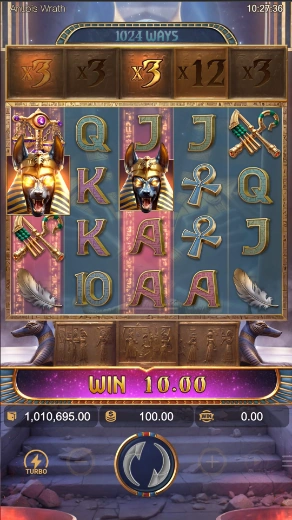
An Anubis symbol appearing on a reel activates the multiplier corresponding to that reel. That window remains activated until the end of the spin. The example shows jackal heads in the first and third columns, with the matching ×3 windows illuminated. Other top windows remain visible, but visibility alone is not the activation condition.
This is a column-based reading. The rule activates a corresponding window when one or more Anubis symbols appear on its reel; it does not describe a separate copy of that window for every jackal head on the same reel. Likewise, a large number in another column does not join the calculation simply because it looks more prominent.
The timing is important in a collapsing-reel game. Activation is retained through the spin, rather than being discarded merely because the grid changes during a later falling-symbol round. The end-of-spin rule then uses the activated set. This is why a single intermediate grid is not always enough to reconstruct the final amount.
Add the active values before applying the result
For a hypothetical main-game calculation, suppose the spin’s win before this feature is 20 and the only activated values are ×3 and ×3. Their sum is 6, so the feature calculation is 20 × 6 = 120. Using 20 × 3 × 3 = 180 would apply a different rule. These are invented amounts to explain the arithmetic, not the cash figures from the screenshot.
Do not include an unactivated ×50 or ×500 in that sum. Also keep the unit clear: the multiplier is applied to the total win of the spin under the stated feature condition. It is not a direct payment of 500 currency units, and it is not a promise that the spin will produce a positive underlying win.
| Visible item | How to read it |
|---|---|
| Five top windows | Potential values associated with the five reels |
| Anubis on a reel | Activates that reel’s corresponding window |
| Several activated windows | Add their values for the multiplier calculation |
| WIN amount | Cash result, separate from the top-window values |
| 1024 WAYS | Win-evaluation format, not a multiplier |
Fifteen free spins introduce a retained total
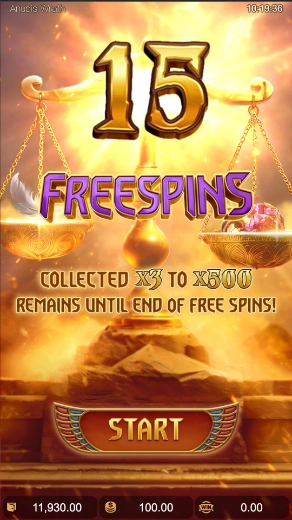
Three Scatter symbols appearing anywhere trigger 15 free spins. Each additional Scatter adds three more free spins. That is this title’s documented trigger, rather than a generic “three symbols equals ten spins” rule. A Wild cannot be counted as a Scatter: its substitution rule explicitly excludes Scatter, and Wilds appear only on reels two to five.
The opening screen states that collected multipliers remain until the end of free spins. In the formal rule, multipliers awarded during a free spin are added to a total retained below the reels for the remainder of the feature. That creates a longer retention period than an ordinary top window, which remains activated only until the end of its current spin.
At the end of a free spin with an activated window, the rule includes the sum of the activated multipliers and the retained total below the reels in the multiplier calculation for that spin’s win. Read those two displayed parts together. Do not replace this with the main-game-only sum, or multiply a current window by the retained total as though the rule described two independent multiplication stages.
Read cash, collected multipliers and remaining spins separately
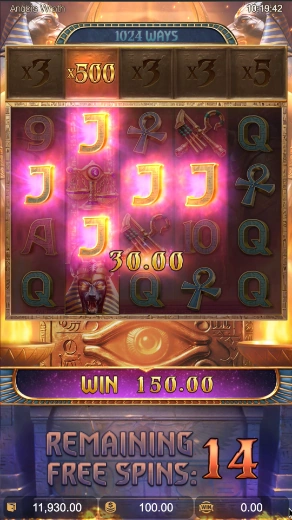
The free-spin result image shows 14 remaining free spins, a WIN amount and a top row of multipliers. Fourteen is a counter for future free spins; it is not the multiplier on the displayed win. The cash amount is not a count of collected jackal heads either. Treating every large number as the same kind of quantity makes the screen much harder to follow.
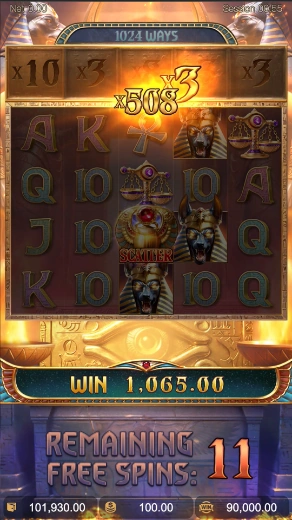
Another official frame catches a multiplier transfer, with ×508 and a glowing ×3 visible above the grid. A collected total can be different from an individual window’s ×3-to-×500 range, because it represents additions during the feature. The individual-window range is not a rule that every accumulated display must stop at 500.
This is an animation frame, not a complete ledger. It does not identify every previous award, show an uninterrupted history from the opening screen, or by itself settle the order in which every changing label updates. Read the completed recorded result when checking an amount; do not count the same value twice just because it appears both moving across the screen and in a retained-total display.
Three boundaries that prevent common misreadings
First, retained does not mean permanent. The free-spins total stays until that feature ends; the rule does not describe a multiplier saved indefinitely to an account or carried into every later main-game spin. Free spins can retrigger, but that statement does not turn the collected value into a separate cash balance.
Second, ×500 is a multiplier value, while the documented maximum win is 10,000 times the bet amount. The manufacturer states that the spin ends when the total win in the main game or free-spins feature reaches that maximum. The two limits use different objects and should not be substituted for one another.
Third, reading an activation correctly explains a displayed or recorded result. It does not tell you when an Anubis symbol will appear next. No screenshot here is evidence that an inactive high-value column is due to activate, and none is a record of the author playing a Vegas11 account.
Quick questions about the screen
Is the red-gem Wild also the Anubis activator?
The manufacturer names them separately. Wild substitutes for eligible symbols other than Scatter; the Anubis symbol activates the multiplier corresponding to its reel. Do not assign the activation role from the word Wild alone.
Does one visible ×500 apply to the whole row immediately?
No. It must be the corresponding activated window under the feature rule. The timing then matters: the calculation is made at the end of the spin, and free spins also have the retained-total rule.
Source: PG SOFT, Anubis Wrath English game information, version 1.0.r3, pages 3–8, retrieved 18 November 2026. Images are the manufacturer’s actual example game screens. They do not establish current availability, currency settings or a matching client build on Vegas11.