
A slot has produced ten losing spins, and the next one feels overdue. For independent rounds under unchanged rules, the losing streak does not make the next round more likely to win. Raising your stake to “catch the return” increases the money exposed without establishing that the next result has become more favourable.
Some games carry feature progress between rounds, such as collected tokens; check those published rules separately. A published state change is different from a belief that losses must be repaid. If you cannot tell which one you are looking at, pause and read the feature rules before another paid spin.
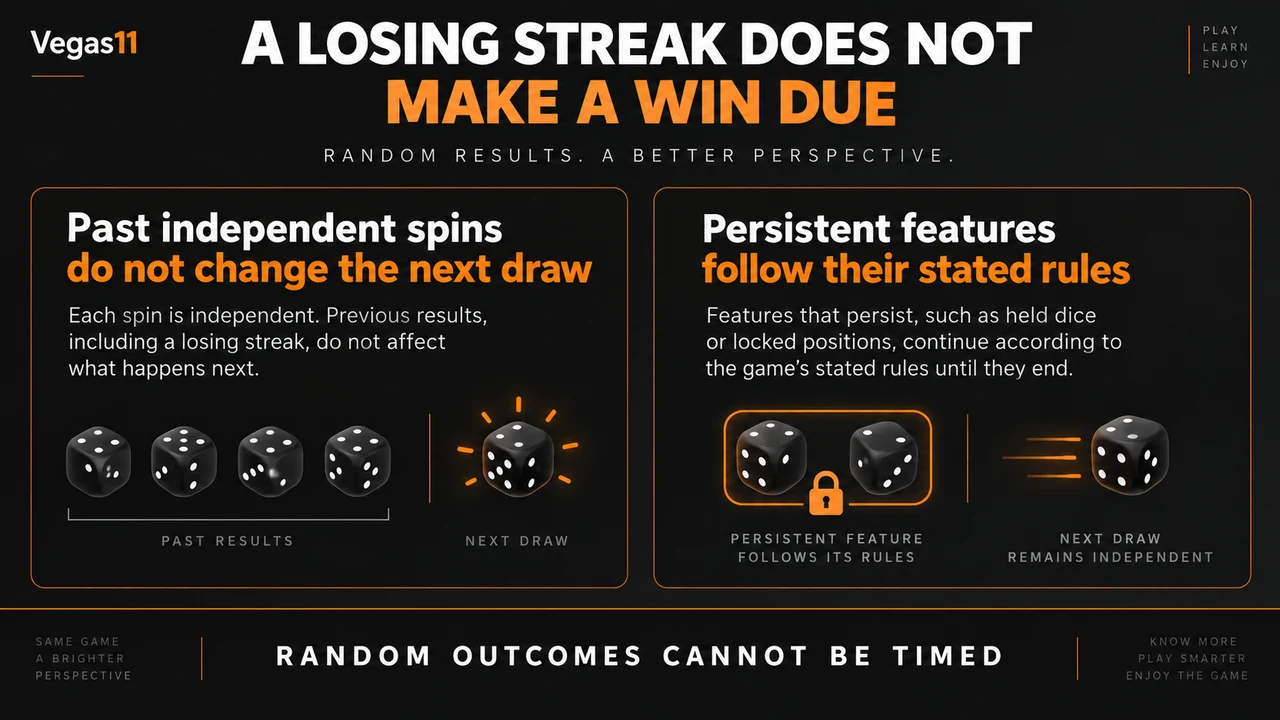
The next draw does not owe you a correction
Consider an invented game with a 20% chance of any paid result on each independent round. After one losing round, the chance on the next remains 20%. After ten losses, it is still 20%, provided the model and rules have not changed. The chance of a loss on the next round remains 80%.
The chance of ten losses from a specified starting point is 0.8 multiplied by itself ten times, about 10.7%. That is an original arithmetic illustration, not a probability measured for any Vegas11 slot. It shows why a sequence can feel unusual without changing the conditions of the next draw. A paid result in this example also need not exceed the stake.
For that distinction, read hit frequency versus RTP. Counting outcomes that pay anything answers a different question from measuring long-run return or the probability of finishing a session ahead.
Random does not mean an evenly spaced pattern
An unpredictable sequence can contain clusters, runs and long gaps. The screen is not obliged to alternate losses and wins or to make a short session resemble a published average. An alternating pattern is not required for randomness, and a losing streak alone cannot show whether the software works correctly.
The British Gambling Commission standard for random outcomes describes acceptably random results and rejects compensated behaviour in its scope. That is a reference for understanding the concept. It is not a statement that Vegas11 is licensed by the Commission or that we have tested any game’s implementation.
A collection meter is a different kind of information
Imagine a published feature that activates after five qualifying tokens have been collected, and the current meter shows four. The meter can tell you about that feature’s state because the rule gives it a defined role. It does not establish how soon the fifth token will arrive, how much the feature will pay, or whether continuing is affordable.
Compare that with four ordinary losing rounds and no collection rule. The number four is only a history count. It has no stated trigger function. Look for a published collection rule before treating a history count as progress toward a feature.
| Observation | What it may explain | What it does not establish |
|---|---|---|
| Ten ordinary losses | Your past spending and results | A debt owed by the next spin |
| Four of five published tokens | A defined collection state | The time or cost to finish it |
| A high stated RTP | A long-run design reference | A short-session refund |
| A highlight reel | Selected past outcomes | The probability of your next round |
Changing the stake is a spending decision
If one spin costs 1.00 and you change it to 3.00, the next ordinary stake is three times larger. Do not call that a recovery plan. Even when a game scales prizes with stake, scaling a possible prize does not prove that a winning outcome is more likely.
Read the RTP explanation before treating a return percentage as a balance target. Also check whether a changed stake affects a feature under the actual rules; there is no universal relationship you can safely assume from the button alone.
What a session record is actually good for
Record time, stakes, returns and the point at which you wanted to increase spending. That record can show whether you kept your limit. A handful of outcomes cannot verify a random-number generator or prove that a machine is “hot” or “cold.” Those are much stronger claims than the observations support.
Use deposit limits, time-outs and self-exclusion if the urge to continue is driven by recovering losses. Stop when the money or time boundary you set has been reached, even if a feature meter is unfinished. An incomplete meter does not turn another stake into an obligation.