
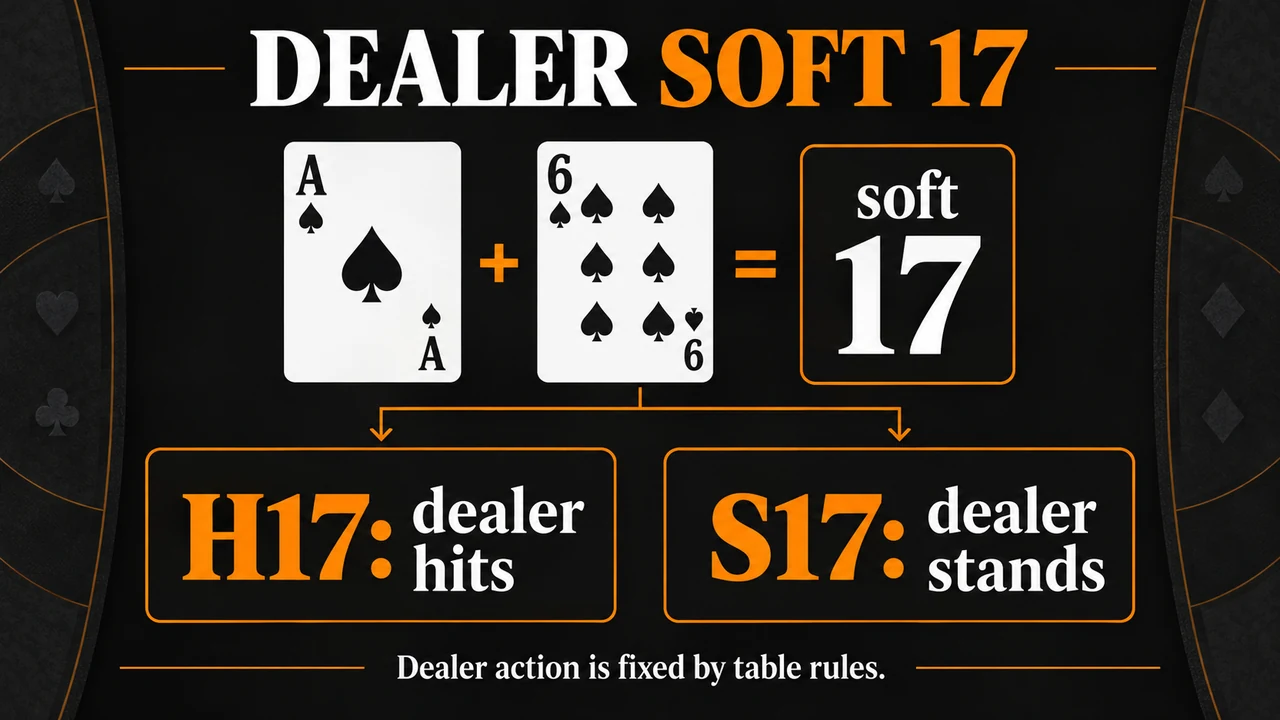
The dealer has Ace–6 and takes another card. At a table marked “dealer hits soft 17,” that is the required action. At a table that stands on all 17s, the same hand stops. The dealer is following the posted rule, rather than choosing whichever move looks more favourable against your hand.
Before playing, find that rule in the table information. The examples here explain ordinary blackjack hand values and the two common dealer instructions; they are not a strategy chart or a description of every Vegas11 table. If “17” is stated without explaining soft hands, pause and ask which rule applies.
What makes a 17 soft?
A soft hand has an ace that can currently count as 11 without putting the hand over 21. Ace–6 is therefore 17 with the ace valued at 11, and it can also be treated as 7 with the ace valued at 1. That flexibility makes it soft 17.
A 10–7 hand totals 17 without an ace that can take the higher value. It is hard 17. A multi-card hand can be soft too: Ace–2–4 totals 17 with the ace at 11. Count the hand, rather than using the number of cards to decide whether it is soft.
For more ace examples, read hard, soft and split blackjack hands. A visible ace is not enough by itself: it must still be possible to count that ace as 11.
H17 and S17 are instructions to the dealer
H17 means the dealer must draw on soft 17. S17 means the dealer stops on soft 17 as well as hard 17. The Seminole Casino Immokalee blackjack rules describe dealer action and note that selected games hit soft 17. A separate regulator-hosted live-blackjack rule sheet gives an example that stands on any 17. These illustrate the difference; they are not evidence of Vegas11 table availability.
| Dealer hand | Current total | H17 table | S17 table |
|---|---|---|---|
| Ace–6 | Soft 17 | Draw | Stand |
| Ace–2–4 | Soft 17 | Draw | Stand |
| 10–7 | Hard 17 | Stand | Stand |
| Ace–6–10 | Hard 17 | Stand | Stand |
Follow one additional card through the total
Start with Ace–6 at an H17 table. If the dealer draws a 3, the hand becomes soft 20: 11 + 6 + 3. If the dealer draws a 10, keeping the ace at 11 would make 27, so the ace counts as 1 and the hand becomes hard 17. Hitting soft 17 does not mean the dealer keeps drawing on that hard 17.
If the added card is a 5, Ace–6–5 becomes hard 12. Ordinary dealer drawing instructions then apply to that new total. The original “17” does not freeze the hand’s value, and the ace does not remain 11 when it would cause a bust.
These examples are hand arithmetic, not predictions about which card will arrive. They also show why “the dealer had 17, so the round was finished” is incomplete without the soft-hand rule.
Your own soft hand is a separate decision
The dealer’s instruction does not tell you to copy it with your own Ace–6. Player decisions depend on the dealer’s upcard and the complete table rules, including available doubles and splits. A chart prepared for a different rule set may give an inappropriate answer for the table you have opened.
Check a strategy chart prepared for the full rules of your table before deciding how to play your own soft 17. The posted H17 or S17 rule explains why the dealer must draw or stop.
Read more than one label before comparing tables
H17 or S17 is one rule among several. Check the natural-blackjack payout as well; 3:2 versus 6:5 explains why identical-looking blackjack tables may pay a natural differently. Number of decks, split restrictions and dealer-blackjack treatment also belong to the full comparison.
Do not quote an exact house-edge adjustment without identifying all those assumptions and the player decisions used in the calculation. Whether the dealer hits or stands on soft 17, the rule does not guarantee your result or justify a larger stake.
If the dealer action looks wrong
Record the complete hand, the round identifier and the table’s rule text. Ace–6 and Ace–6–10 should not be described as the same soft total. Wait for the recorded result, and raise a specific question about the action that differs from the posted rule.
Our live-dealer blackjack round-flow guide helps with betting windows and settlement. Keep the stake and time limit fixed while resolving any uncertainty, and do not place another round solely to challenge the dealer’s previous action.