
Quick answer: This guide explains blackjack insurance: how the side bet works in plain language. Exact game rules, account terms, limits, and availability can vary, so the current screen and written terms should control.
Prepared by the Vegas11 Editorial Team. Sources and limits checked August 19, 2026.
Casino games involve financial risk. Adults 18+ only. Play only where permitted, set a fixed money and time boundary before playing, and do not chase losses.
Insurance appears after a dealer ace
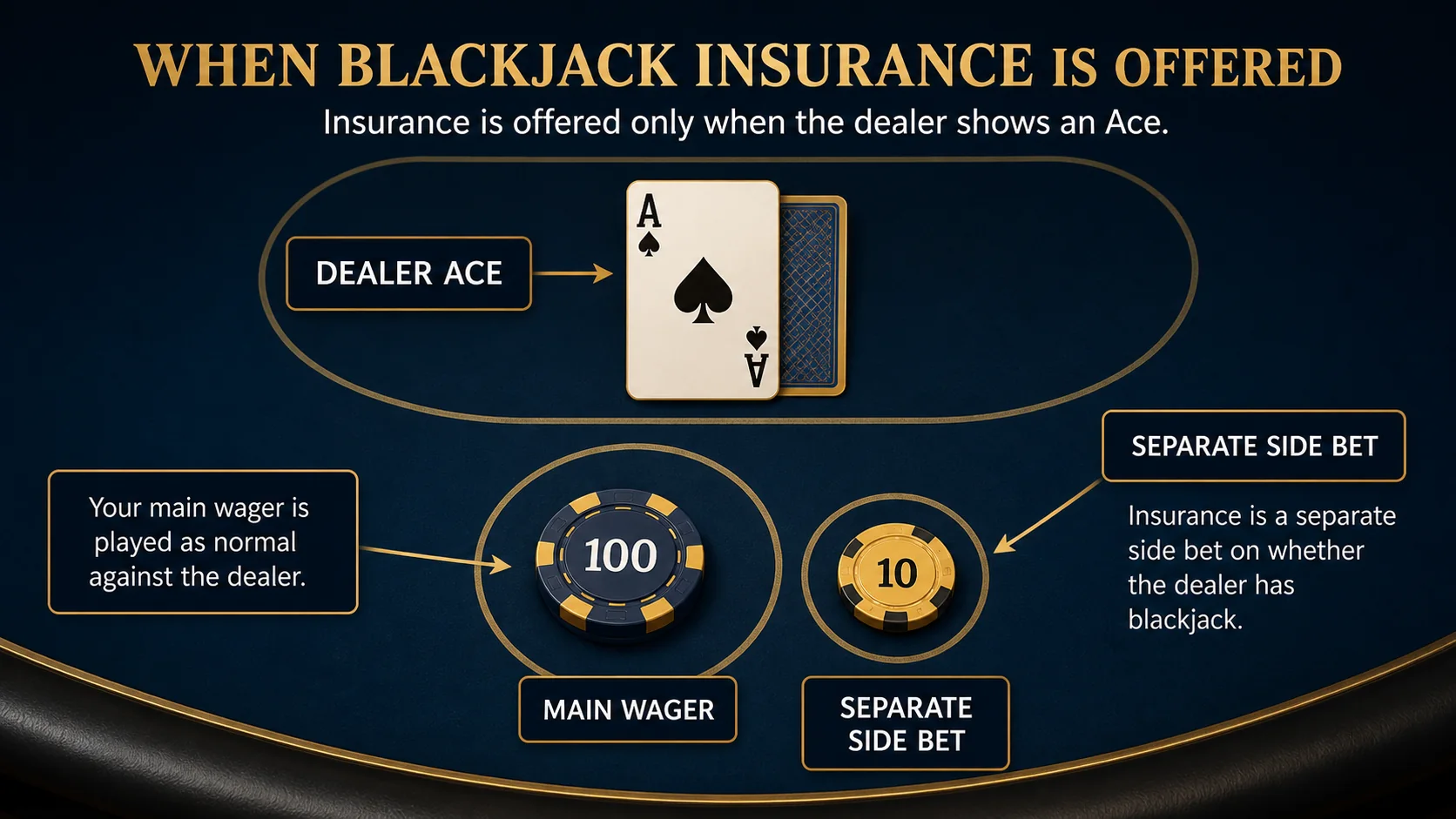
In blackjack, insurance is normally offered only when the dealer’s visible card is an ace. It is a separate side bet placed alongside the main hand, not an instruction that changes the value of the hand already being played.
The exact prompt, timing, and amount can vary by table. The useful first step is to pause long enough to read the displayed rule instead of treating the word ‘insurance’ as a promise that the main stake is protected.
| Term | What to read | What not to infer |
|---|---|---|
| Displayed rule | The exact game or account condition | That similar products use the same rule |
| Timing | When a choice or request is accepted | That a result or payment is due |
| Limit | Minimum, maximum, or time boundary | That more stake creates a better outcome |
| Settlement | How the final status is shown | That an animation or headline is proof |
How the side bet is calculated
A common structure allows an insurance wager up to half of the original blackjack stake. If the dealer has blackjack, the side bet is commonly shown as paying 2:1; if the dealer does not have blackjack, the insurance wager loses under that rule. The table’s own help text controls the settlement.
That means the side bet has a different condition from the main hand. It is possible for the insurance bet to settle one way while the main blackjack hand settles another way. Keeping those two records separate prevents confusing the side-bet return with the total result.
Insurance is not the same as even money
Even money is a separate table decision that may be offered when the player has a natural blackjack and the dealer shows an ace. Some interfaces use language that sounds similar, but the settlement and house rules should be read on the exact table.
The safest habit is to ask three questions: what is the side bet amount, what event triggers its payout, and how does the screen display the result? If the wording is unclear, do not assume that one option is another.
| Before acting | Check | Keep a record of |
|---|---|---|
| Rules | The exact product or account wording | Version or update date |
| Money | Fees, stake, limit, or contribution | Amount and time boundary |
| Access | Verification, device, or support route | Ticket or round ID |
| Afterward | Settlement or account status | Screenshot or confirmation |

A short reading checklist
Before selecting insurance, check the maximum side-bet amount, the payout display, the dealer-blackjack definition, and whether the table rules mention any special procedure. Then compare the decision with the fixed money boundary you set for the session.
Insurance is a rules question, not a way to turn a losing session into a predictable outcome. The main hand, the side bet, and the session limit should remain separate in your notes.
Frequently asked questions
Do the displayed terms apply everywhere?
Not necessarily. The exact game, account, operator, market, and current version control the terms.
Can one number predict my session?
No. A published figure describes a defined rule set or long-run concept, not an individual result.
What if a rule is unclear?
Pause and use the official help or support route before acting.
Should I save the terms?
Yes. Keep the version date, screenshot, confirmation, or ticket number when available.
What is the practical control?
Set a fixed money and time boundary and stop when either boundary is reached.
Source and update note
This article is informational and time-qualified. Current game, account, payment, and responsible-play terms control over this general explanation. Sources checked: source 1.