
A slot menu shows a coin value of 0.05, yet the next spin costs 1.00. That can be correct: the coin value may be only one part of the stake. Read the total bet in currency before pressing Spin, and stop if you cannot explain how the displayed controls produce that amount.
The examples below use invented amounts to explain the arithmetic. They are not Vegas11 minimum bets or a price list. Some slots use coins and lines; others display a single total stake. The rule panel for the game you open decides which calculation applies.
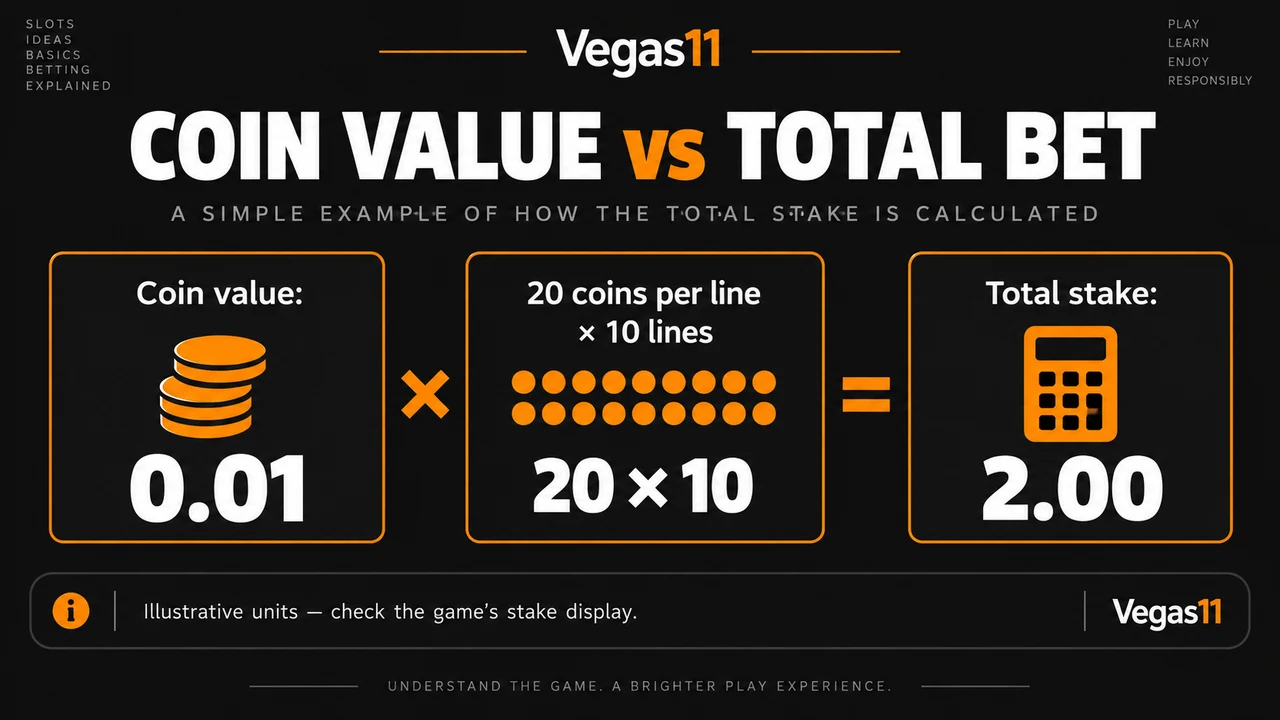
Three numbers that can describe one stake
Coin value is the monetary value assigned to a coin or credit. A bet level may specify how many of those units are assigned to each line. The number of active lines can then determine how many line bets you are placing at once. A label such as “Bet 1” does not necessarily mean one unit of your account currency.
PokerStars explains a line-based format in which coin value multiplied by the number of paylines gives the total bet. That is an example of a particular control system, rather than a formula for every slot. When a separate coins-per-line setting exists, its rule also belongs in the calculation. Read the operator’s coin-value explanation for the scope of that example.
| Control | Example setting | Meaning in this example |
|---|---|---|
| Coin value | 0.05 | One coin is worth 0.05 |
| Coins per line | 1 | One coin is assigned to each line |
| Active lines | 20 | Twenty line bets are included |
| Total stake | 1.00 | 0.05 × 1 × 20 |
Changing the denomination can change every line
Keep the line count at 20 and the coins-per-line setting at one. Raising the coin value from 0.05 to 0.10 doubles the total stake from 1.00 to 2.00. A small coin value can still produce a larger total stake when it applies across many lines. Compare the total before and after the change, rather than comparing the coin values alone.
Now leave coin value at 0.05 and raise coins per line from one to three. The total becomes 0.05 × 3 × 20 = 3.00. A player who remembers only the original 1.00 price could spend three times the intended amount on the next ordinary spin. The arithmetic is simple; the mistake is reading one control as if it were the whole price.
A ways count is not a line count
A lobby might advertise hundreds or thousands of ways to win. Do not multiply your displayed stake by that number unless the game explicitly instructs you to do so. A ways count describes how qualifying symbol combinations are evaluated; it does not automatically describe how many separately priced bets you purchased.
Our guide to slot paylines and grids explains the display distinction. If the game uses a fixed total-bet selector, read that total directly. Using a line-based formula for a ways game can give the wrong spin cost.
Reconcile the price with the transaction
Use a hypothetical balance of 50.00 and a confirmed stake of 2.00. A losing round with no other transaction would leave 48.00. If the round returns 0.80, the balance would be 48.80: the paid result is not the same thing as a profit. This calculation checks the stake and return; it says nothing about the next outcome.
If your real record does not reconcile, inspect the round history for an added feature charge, a different currency, a pending result or another transaction. Save the round identifier and ask support to explain the specific difference. Do not place another bet merely to test whether the balance changes again. The Gambling Commission’s transaction-display standard is a British reference for explaining stakes and conversions, not proof of this site’s regulatory status.
Keep the total visible when changing games
A new game may open with a different default stake or remember a setting from an earlier visit. Recheck the total after loading, changing denomination or returning from a feature screen. Read the confirmation for any paid feature separately; a base-spin label does not explain every optional purchase.
For a smaller advertised entry amount, use the low-bet slot guide as background, then confirm the actual current currency amount. Before committing money, set a limit you can afford to lose and use deposit limits or a time-out when needed. Knowing the total stake helps you keep your spending limit; it does not make a winning spin more likely.
Does a higher coin value improve the odds?
You cannot conclude that from the denomination alone. A larger stake can scale a displayed payout, but a rule-dependent feature or eligibility condition must be read separately. Compare the exact paytable before assuming a higher cost buys a different probability. If the relationship is unclear, leave the setting unchanged and pause.