
Two roulette tables advertise a 35:1 payout for a one-number bet, but one wheel has 0 and the other has both 0 and 00. The payout can be the same while the chance of hitting that number differs. In standard equal-pocket roulette, single-zero has 37 possible results and double-zero has 38.
This comparison assumes traditional payouts and equally likely pockets. Multiplier tables and other variants can use different terms. Read the actual wheel and paytable before placing chips, and pause if the table’s name and rules do not agree.
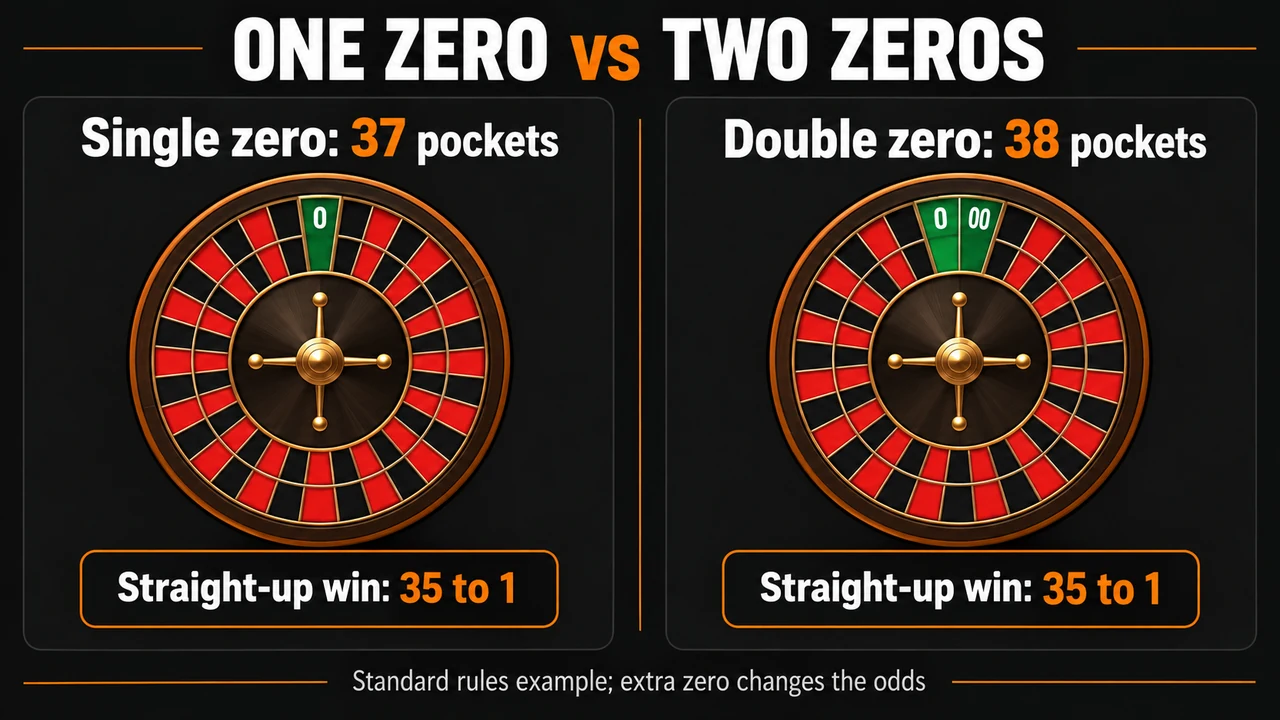
Count outcomes before comparing the prize
Evolution’s roulette range describes the single-zero and double-zero layouts. The Singapore regulator also publishes double-zero roulette rules with a standard one-number payout of 35:1. Those examples establish the rule formats; neither confirms which tables Vegas11 currently offers.
For a straight-up bet on one ordinary number, the standard single-zero probability is 1 in 37. It is 1 in 38 on double-zero. The number of winning pockets is unchanged. The extra green pocket simply adds another way for that same bet to lose.
Our roulette table-layout guide explains where those pockets appear on the betting grid. Check the actual 00 area rather than relying only on the label “American” or the colour of the table.
What 35:1 returns on a 10-unit stake
For a hypothetical 10-unit straight-up bet, a 35:1 win earns 350 units of profit plus the returned 10-unit stake: 360 credited in total. A losing result costs the 10-unit stake. The distinction between profit and total credit matters when comparing the paytable with the account history.
For a standard single-zero wheel, the expected net result per such bet is (350 × 1/37) minus (10 × 36/37), or about −0.2703 units. Divide by the 10-unit stake and the house edge is about 2.70%. The equivalent double-zero calculation is (350 × 1/38) minus (10 × 37/38), or about −0.5263 units: approximately 5.26%.
These calculations assume equally likely pockets and the standard 35:1 straight-up payout. They do not forecast a session or promise that losses will stay near those amounts. Actual results can be far above or below the expectation.
| Standard wheel | Pockets | One-number win chance | House edge for standard straight-up bet |
|---|---|---|---|
| Single-zero | 37 | 1/37 | About 2.70% |
| Double-zero | 38 | 1/38 | About 5.26% |
Red and black are not exactly a coin toss
Both standard wheels have 18 red numbers and 18 black numbers. Red therefore wins on 18 of 37 pockets on single-zero and 18 of 38 on double-zero. A green result is neither red nor black. Even-money pricing does not mean an exactly 50% chance of winning.
The same standard house-edge percentages apply to ordinary red/black bets with full loss on zero. But an additional rule such as La Partage changes eligible zero settlement. Do not apply a percentage from one rule set to another without reading the exceptions. The inside and outside bets guide explains coverage; coverage and zero treatment are separate checks.
A lower percentage can still cost more per round
Suppose the single-zero table requires a 100-unit stake while a double-zero table allows 10 units. Under these examples, expected loss per round would be about 2.70 units at the first table and 0.53 units at the second. The first has the lower percentage but the larger amount at risk.
That does not make either table a recommendation. It shows why comparing only a house-edge label can miss the decision that affects your spending. Round pace and the sum of all chips on the layout also matter. Add all five stakes together when checking how much you can lose in the round.
Check for changed straight-up terms
A multiplier roulette variant may change the ordinary straight-up payment or add a fee. The standard 35:1 example cannot be carried over automatically. Read the base payout, any multiplier eligibility and the total amount charged for the round as one complete rule set.
Before choosing a table, identify the wheel, the precise bet, the payout and the total stake. Use account limits and time-outs if the faster pace or higher minimum makes your original boundary hard to keep. A better-understood table remains a gambling product with uncertain results.