
Quick answer: This guide explains progressive jackpot slots: contributions, resets and eligibility in plain language. Exact game rules, account terms, limits, and availability can vary, so the current screen and written terms should control.
Prepared by the Vegas11 Editorial Team. Sources and limits checked August 19, 2026.
Casino games involve financial risk. Adults 18+ only. Play only where permitted, set a fixed money and time boundary before playing, and do not chase losses.
What a progressive meter describes
A progressive jackpot meter is a displayed prize value that can change as qualifying play occurs. In a networked product, contributions may be linked to a group of games or a defined qualifying wager. In a local product, the pool and rules may be narrower.
The visible number is therefore part of a rule system. It is not a countdown, a forecast, or a sign that the next round is more likely to produce the top prize.
| Term | What to read | What not to infer |
|---|---|---|
| Displayed rule | The exact game or account condition | That similar products use the same rule |
| Timing | When a choice or request is accepted | That a result or payment is due |
| Limit | Minimum, maximum, or time boundary | That more stake creates a better outcome |
| Settlement | How the final status is shown | That an animation or headline is proof |

Contributions are not the same as eligibility
A game can add to a progressive pool while still requiring a particular stake, feature, bet level, or trigger condition for a player to qualify. The contribution rule and the eligibility rule should be read separately.
Some interfaces also display a seed value, a reset value, or a range of possible prizes. Those values explain the pool’s structure; they do not turn a session into a predictable opportunity.
Reset language matters
After a jackpot is awarded, a progressive pool may reset to a stated starting value or follow another published rule. The reset does not necessarily mean the next prize will grow at a fixed rate, because the qualifying activity and network conditions can differ.
When a game help page uses words such as ‘up to’, ‘starting from’, or ‘subject to’, keep those limits in the explanation. A headline meter without its conditions is incomplete.
| Before acting | Check | Keep a record of |
|---|---|---|
| Rules | The exact product or account wording | Version or update date |
| Money | Fees, stake, limit, or contribution | Amount and time boundary |
| Access | Verification, device, or support route | Ticket or round ID |
| Afterward | Settlement or account status | Screenshot or confirmation |
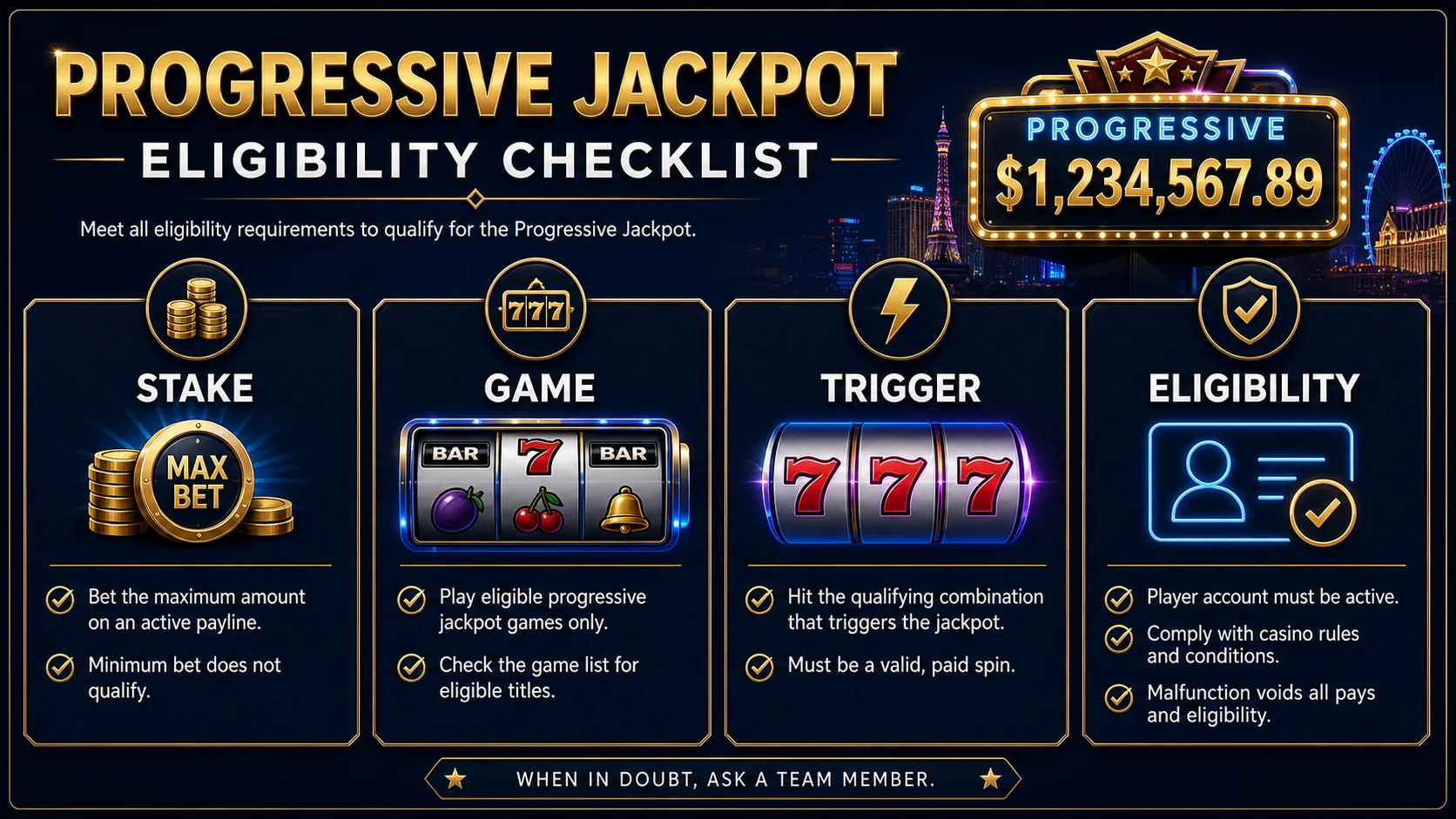
A meter-reading checklist
Before playing, look for the qualifying stake, the trigger event, the reset or seed wording, the participating game list, and any geographic or account eligibility condition. Save the current rules if the product offers a version or help page.
The practical conclusion is simple: read the mechanics, keep the amount and time boundary fixed, and do not increase a stake because the meter looks large.
Frequently asked questions
Do the displayed terms apply everywhere?
Not necessarily. The exact game, account, operator, market, and current version control the terms.
Can one number predict my session?
No. A published figure describes a defined rule set or long-run concept, not an individual result.
What if a rule is unclear?
Pause and use the official help or support route before acting.
Should I save the terms?
Yes. Keep the version date, screenshot, confirmation, or ticket number when available.
What is the practical control?
Set a fixed money and time boundary and stop when either boundary is reached.
Source and update note
This article is informational and time-qualified. Current game, account, payment, and responsible-play terms control over this general explanation. Sources checked: source 1, source 2.