
A silver-framed symbol in Caishen Wins is not already a Wild. If it participates in a win, it changes after the next cascade into a randomly selected non-Wild symbol with a gold frame. A gold-framed symbol must then participate in a win before its own next-round transformation into two to four Wilds.
The game also has a separate top-reel feature: a fully appearing four-symbol-wide Success Caishen block becomes four Wilds. The actual game screens below show why the framed-symbol route and the wide top block should not be treated as the same trigger.
The extra top reel covers the four middle reels
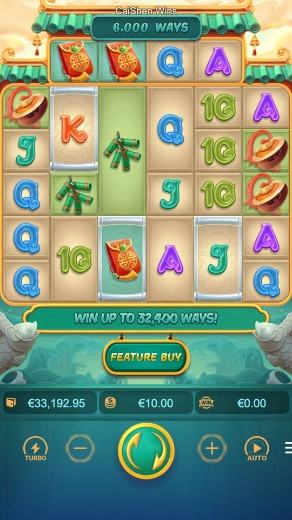
The main layout has six reels and five rows, with an additional reel above reels two, three, four and five. The stated ways range is 2,025 to 32,400. Ordinary pictures include hats, bamboo, red packets, a frog, a lion and card ranks.
Some symbols on the middle four reels can occupy two to four spaces. The paytable says each such large symbol represents one symbol during payout calculations. Its visual height is therefore not an instruction to count every occupied space as a separate paying copy.
Wilds substitute for all symbols except Scatter and appear only on reels two to five. That exclusion also matters for feature entry: a Wild that helps an ordinary winning combination is not a replacement Scatter for triggering free spins.
A silver frame needs a qualifying win first
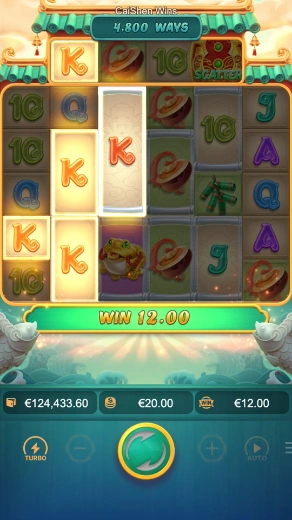
During a spin, some non-Wild symbols on reels two to five that occupy two to four spaces may have a silver frame. In the supplied example, the highlighted K result includes a tall silver-framed K on the third reel.
The formal rule refers to a silver-framed symbol that was involved in the previous round’s win. At the new round, after new symbols cascade down, that qualifying symbol transforms into a randomly selected symbol other than Wild, now with a gold frame.
This is a conditional, timed change. A silver border alone is not an immediate Wild award on landing. The previous winning result and the next-round point after the cascade are both part of the mechanism.
The replacement is described as randomly selected, so the original K picture is not guaranteed to stay a K. Nor does the first stage promise a Wild: the rule explicitly excludes Wild from this silver-to-gold selection.
The gold-framed Q is still an ordinary symbol
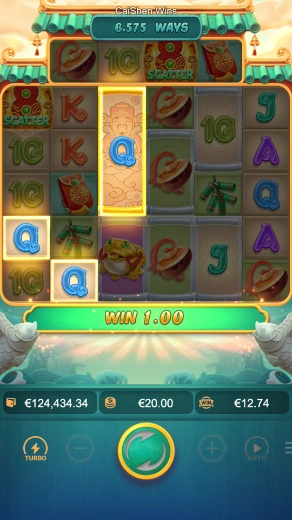
The gold-frame illustration contains a tall Q highlighted with other Q symbols. It demonstrates the intermediate stage: the framed picture is still an ordinary symbol participating in a symbol win, rather than a Wild merely because its border is gold.
At the new round after the next cascade, a gold-framed symbol that participated in the previous win becomes two to four Wild symbols. The number depends on the spaces that the gold-framed symbol occupied.
The two transitions therefore have separate qualifying wins. Describing them as silver instantly becomes gold and then Wild regardless of results would remove the winning conditions from the written rules.
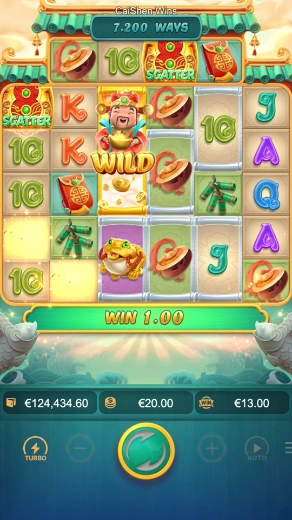
The manufacturer’s next illustration shows the Caishen Wild transformation around the third-reel position. The artwork is an animation state; the formal rule explains the resulting two-to-four Wild count. A still showing one large character should not override that stated count with an assumption of exactly one final Wild.
This also explains why symbol size has different meanings before and after conversion. A large ordinary symbol is counted as one in the ordinary payout calculation. The gold-to-Wild rule then explicitly creates two to four Wilds based on its occupied spaces.
| Stage | Condition | Next described result |
|---|---|---|
| Silver-framed large symbol | Participated in the previous round’s win | After the cascade: randomly selected non-Wild symbol with a gold frame |
| Gold-framed large symbol | Participated in the previous round’s win | After the cascade: two to four Wilds according to occupied spaces |
| Four-wide Success Caishen top block | Fully appears in the additional top reel | Transforms into four Wild symbols |
The wide top block has its own full-appearance condition
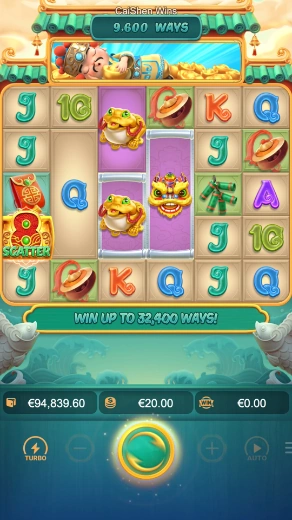
The Success Caishen feature can place a block four symbols wide on the additional top reel. In this example the character and its artwork stretch across the four middle positions, distinct from a tall silver- or gold-framed ordinary symbol in the main grid.
If the whole block appears in the additional top reel, it transforms into four Wild symbols. The stated condition is full appearance of this wide block. It is not the previous-win condition used for the framed-symbol route.
The document does not say that a partly appearing block is sufficient. It also does not instruct the reader to count any ordinary four pictures in the top row as the Success Caishen block. Recognize the specific character block before applying its rule.
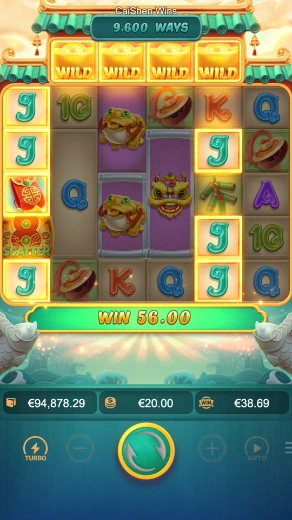
The transformed example shows four separate Wild ingots across the additional top reel, with J symbols highlighted below. This makes the difference visible: one wide piece of character artwork supplies four Wild symbols when its own condition is met.
That example does not imply every top-reel Wild must have come from a silver-framed K, or that the top block requires two successive ordinary-symbol wins. Those would combine conditions from two different features.
Eight free spins and ×8 are two separate awards
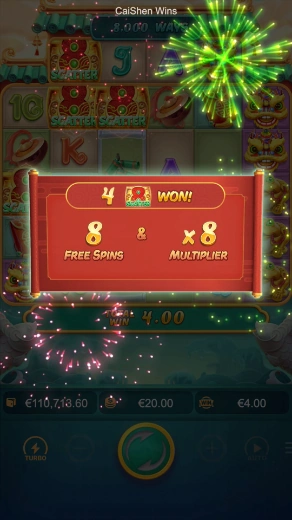
Four or more Scatters anywhere trigger the free-spins feature. The initial award offers eight free spins with ×8 for all wins, adding two free spins for each extra Scatter that triggered the feature. The supplied entry screen shows four Scatters, eight turns and ×8.
Although both fields say eight, one counts turns and the other is a multiplier. Five triggering Scatters give ten initial turns under the extra-two rule; that extra turn award does not, by itself, raise the initial multiplier from eight to ten.
The rules separately describe an optional gamble for more turns or a higher multiplier. A successful turn gamble adds two spins; a successful multiplier gamble increases that multiplier by two. Failure ends the feature. These optional changes should not be described as automatic benefits of landing an extra Scatter.
Once inside free spins, four Scatters award eight more turns and each additional Scatter adds two more. That in-feature turn award is again separate from the silver-frame transformations and from the Success Caishen block. Neither a framed ordinary symbol nor a Wild substitutes for the required Scatter.
Cash amounts do not identify the transformation stage
The silver and gold examples display WIN 12.00 and WIN 1.00 respectively. Those cash banners describe the supplied example results. They are not frame levels, a guaranteed payment for each conversion, or enough information to reconstruct every intervening balance update.
The parameter table separately lists an advertised maximum win of 100,000 times the bet amount. That result-limit quantity is different from two-to-four created Wilds, four top-reel positions, eight awarded turns and the initial ×8 multiplier. Keeping their units separate makes the interface much easier to read.
Source: PG SOFT, Caishen Wins English game information, version 1.0.r776, pages 4–9 and 11, retrieved 18 November 2026. Screenshots are actual manufacturer game examples. They do not establish current availability or identical settings on Vegas11 and are not an author’s play history.