
Captain’s Bounty awards ten free spins for three Scatters, then five extra for each additional Scatter. Four Scatters therefore award fifteen, not twelve. During the feature its round-multiplier wheel changes from the main game’s ×1, ×2, ×3, ×5 to ×3, ×6, ×9, ×15.
The wheel values, numbered paying lines and remaining-spin counter each mean something different. These actual game screens show how to tell them apart in this five-reel, twenty-line game, including a ×9 feature state with only three free spins left.
This grid pays on twenty lines
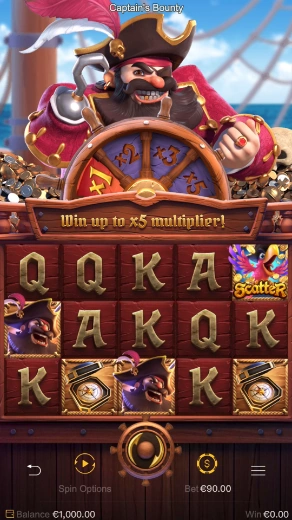
The main grid has five reels and three rows. Its ordinary pictures include hooks, hats, books and card ranks, while the brightly coloured parrot is the Scatter. Above the grid, the captain holds a wheel whose four marked stages provide the current round multiplier.
The manufacturer specifies twenty paying lines. That is different from a ways game where a displayed number describes thousands of combinations. A small number beside a highlighted path on this screen is a line identifier, not a count of free spins or an extra multiplier.
The introduction describes cascading symbols with increasing multipliers. Within a spin, a preceding round’s win advances the next round’s multiplier. It does not require placing separate paid spins to move the wheel through its four stages.
A labelled hook path and the ×3 wheel answer different questions
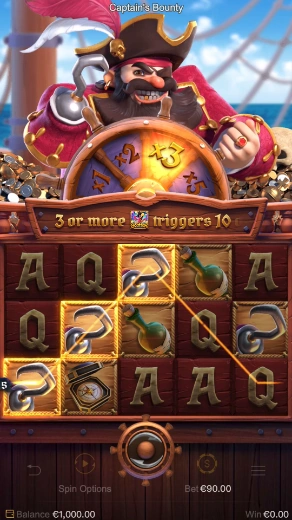
The actual example highlights a bent path through hook symbols and labels that path five. The wheel above it has ×3 selected. The path label identifies the line being illustrated, while ×3 is the multiplier stage for the round.
Counting the line label as a second multiplier would mix the two displays. It does not mean that the visible hook win should be multiplied by three and then by five simply because both numbers appear somewhere in the screen.
Wilds substitute for symbols except Scatter and appear only on reels two, three and four. That exception matters for feature entry: a Wild that can help an ordinary paying line does not become an additional parrot Scatter for the ten-spin trigger.
The main ladder advances after a winning round
The first round starts at ×1. A win in that round increases the second round’s multiplier to ×2. A second-round win increases the third round to ×3, and a third-round win increases the fourth and subsequent rounds to ×5.
The multiplier shown above the reels applies to wins for that round. The ladder is not a sum of all four segments on the wheel. An active ×3 does not invite adding one, two and five, and an active ×5 is not five extra free spins.
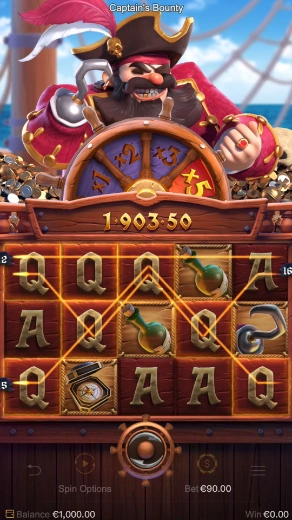
Another supplied screen shows ×5 active and highlighted paying paths through Q symbols. It demonstrates that paying paths and the current stage can be displayed together. Its cash banner belongs to that example and does not reveal every earlier cascade or account transaction.
For a hypothetical main-game sequence with underlying round wins of 8, 3 and 2, the first three stages pay 8 × 1 + 3 × 2 + 2 × 3 = 20. The invented amounts isolate the multiplier calculation; they are not a reconstruction of the pictured 1,903.50 banner.
An extra Scatter adds five free spins here
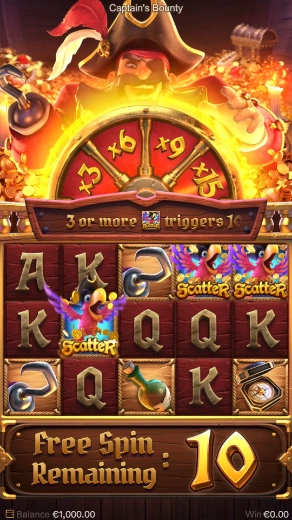
The feature entry example shows three parrot Scatters and ten free spins remaining. The formal rule requires three Scatters anywhere and adds five more turns for every additional Scatter. It does not require the Scatters to form one of the twenty ordinary paying lines.
With four Scatters, the arithmetic is ten plus five, giving fifteen free spins. With five Scatters, it is ten plus two lots of five, giving twenty. These are applications of this game’s written award rule, not a forecast of how many Scatters will land.
An extra-two rule used by another slot cannot be imported here just because its free-spin ladder also ends at ×15. The number of awarded turns and the multiplier ladder are separate features, and both must be checked for the exact game.
| Scatter count at entry | Calculation under the stated rule | Awarded free spins |
|---|---|---|
| Three | Ten initial spins | 10 |
| Four | 10 + 5 | 15 |
| Five | 10 + 5 + 5 | 20 |
The document also says free spins can retrigger. It does not provide a complete historical sequence for each example counter. A separate screenshot therefore cannot establish exactly which previous spins added or consumed every turn.
The feature wheel triples the four stages
During free spins the wheel uses ×3, ×6, ×9 and ×15 instead of ×1, ×2, ×3 and ×5. Each corresponding stage is three times its main-game value. This is a feature ladder for successive winning rounds inside a free spin, rather than a permanent multiplier bank that rises once per free spin consumed.
Using the same hypothetical underlying round wins of 8, 3 and 2, the first three feature stages pay 8 × 3 + 3 × 6 + 2 × 9 = 60. This comparison keeps the symbol wins fixed so that only the changed ladder explains the difference from the hypothetical main-game total of twenty.
The final stage of ×15 applies to the fourth and later rounds under the stated ladder. It does not mean every feature turn is guaranteed to reach that stage. The preceding winning-round conditions still matter.
×9 with three spins left is not a contradiction
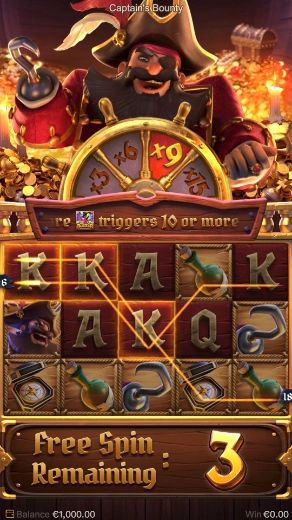
In this actual feature state the wheel highlights ×9 and the counter below the grid says three free spins remain. Nine identifies the current round multiplier. Three tells the reader how many feature turns are left; it does not force the multiplier back to ×3.
The highlighted K symbols and their paths describe the symbol result being illustrated. Those paths, the wheel and the counter can all be visible at once because they describe different parts of the same interface. None is a substitute for reading the others.
The earlier ten-spin entry frame and this three-spins-left frame are supplied manufacturer examples. The article does not invent the exact sequence of intervening wins, retriggers or balances, or claim that an author personally played through them.
Total Win is a result amount, not a new wheel value
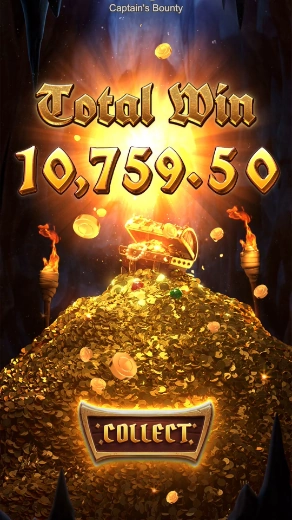
The feature-result illustration displays Total Win 10,759.50. That is a cash amount in the manufacturer example. It is neither a multiplier stage nor an additional-spin award. The Collect button is part of the game’s result interface, not evidence of an operator withdrawal or payment service.
The parameter table separately lists an advertised maximum win of 30,000 times the bet amount. That result-limit quantity is different from the wheel’s ×15 and from any particular example cash amount. It provides no guarantee that a future feature will match the displayed result.
Source: PG SOFT, Captain’s Bounty English game information, version 1.0.r608, pages 3–7, retrieved 18 November 2026. Screenshots are actual manufacturer game examples. They do not establish current availability or identical settings on Vegas11 and are not an author’s play history.