
Cocktail Nights does not automatically add every glass below the grid. A multiplier position is used when a Wild on the reel above it participates in a win. Only the values below those winning Wilds are added, and that sum multiplies the win before payment.
There is also an important difference between modes: every new main-game spin starts the four values at ×2, while free spins start them at ×2 when the feature begins and then retain their evolving values. These real game screens show the selected glasses, their ×4 sum and the replacement values.
Read the four glasses separately from the symbol grid
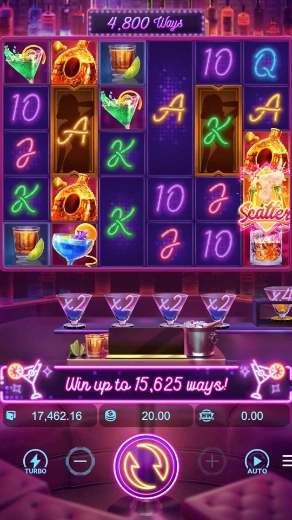
The main game has six reels and five rows, with an additional multiplier reel below reels two, three, four and five. The symbol area contains drinks, card ranks and character symbols; the four glasses underneath supply multiplier values for the rule described here.
The manufacturer gives a range of 400 to 15,625 ways. Some large symbols occupy two to four spaces while representing a single symbol in payout calculations. A taller picture therefore does not mean that each covered space is a separate copy of a winning symbol.
In the shown main screen the four current glasses all read ×2. Another glass is visible at the right edge as a queued preview. Keep that preview separate from the four active positions aligned with the middle reels. Adding a fifth value just because its artwork is visible would change the stated four-position rule.
A Wild has to participate in the win
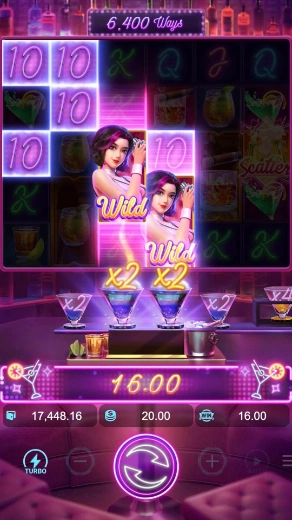
Wilds substitute for symbols except Scatter and appear only on reels two to five. When one or more Wilds appear and are involved in a win, the multiplier values below those Wilds are totalled. The qualification concerns a winning Wild, rather than any Wild somewhere in the grid.
The example highlights two ×2 glasses below two winning Wild portraits. Other glasses remain visible, but their mere presence does not make them additional inputs to this calculation. The reel alignment tells you which values belong to the qualifying Wilds.
Likewise, the rule does not say to count every ordinary winning symbol as another multiplier activation. The paying combination determines the win, while the participating Wild positions determine which bottom values enter its multiplier sum. Those are different jobs within the same round.
Two used ×2 values give the displayed ×4
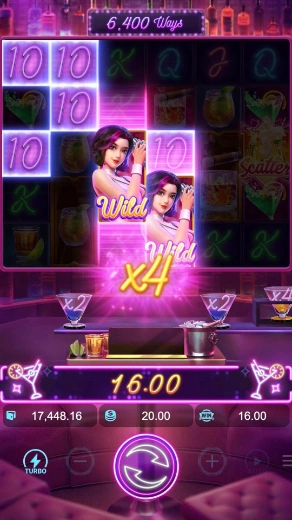
The next illustration displays a large ×4. With the two selected values shown in the preceding example, the calculation is 2 + 2 = 4. The formal rule says that the relevant values are totalled before wins are paid.
In this one case multiplying two by two would also produce four. That coincidence does not turn the rule into multiplication of the glasses. With hypothetical selected values of four and six, the same addition rule gives ten, whereas multiplying them would incorrectly give twenty-four.
For a hypothetical underlying winning amount of 10 and selected values of two and two, the payment calculation is 10 × (2 + 2) = 40. These invented cash amounts explain the operation. They do not reconstruct the manufacturer’s WIN 16.00 animation or its account balance.
The sequence matters: identify the qualifying Wilds, add the values below them, apply the resulting multiplier and pay the win. A later replacement value belongs to the replacement stage; it is not silently included in the payment already being resolved.
Used values are replaced from the right after payment
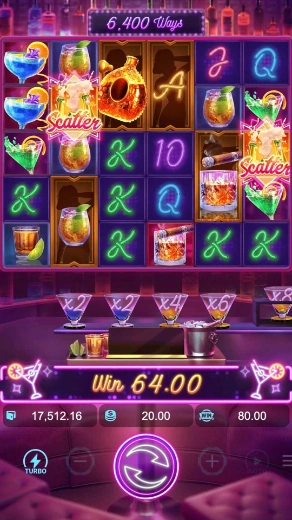
After wins are paid, the used multipliers are destroyed and bigger multipliers cascade in from the right. The supplied replacement screen shows the four current positions as ×2, ×2, ×4 and ×6, with ×8 visible farther right in the preview.
That is an updated array of four values, rather than a claim that all four have just been used together. The next applicable calculation still depends on where winning Wilds participate. A larger stored value can be present without being selected for a particular win.
The picture also does not justify one fixed numerical increase for every glass. The document describes replacement with bigger multipliers from the right. Reading that as every value doubling, or every position increasing by two after every cascade, would add a formula the cited rule does not provide.
Gold-background symbols explain where new Wilds can come from
During any spin, ordinary symbols on reels two to five that occupy two to four spaces may have a gold background. Wild and Scatter symbols are excluded from that description. A qualifying gold-background symbol must have been involved in the previous round’s win.
At the new round, after new symbols have cascaded down, those qualifying gold-background symbols transform into Wilds. The gold background alone is not a promise of an immediate conversion on landing. The previous win and the stated next-round timing both matter.
This feature and the multiplier reel answer different questions. Gold-background conversion explains a route to a Wild; the bottom reel explains how a Wild that participates in a win selects multiplier values. Neither rule says that every gold symbol automatically activates every glass.
Free spins retain the evolving values after feature entry

Four Scatters appearing anywhere trigger ten free spins. Each additional Scatter adds two more, and free spins can retrigger. The opening image awards ten and explicitly says the multiplier reel will not reset until the end of free spins.
At the start of the feature, the four bottom values are set to ×2. During a free spin, winning Wilds select the values below them in the same way: the selected values are added, the win is multiplied before payment, and the used values are replaced from the right after payment.
The difference is the reset boundary. The rules say the bottom values do not reset after the first free spin. This lets the evolving set continue during the feature. It is not an instruction to restart all four glasses at ×2 at the beginning of every free spin.
| Question | Main game | Free-spins feature |
|---|---|---|
| When are four ×2 values set? | Start of each main-game spin | Start of the feature |
| Which values are used? | Below Wilds participating in a win | Below Wilds participating in a win |
| When does the sum apply? | Before that win is paid | Before that win is paid |
| What follows payment? | Used values replaced from the right | Used values replaced from the right |
| Do values reset every new free spin? | Not a main-game rule | No; they persist within the feature |
A nine-spins-left display contains several different numbers
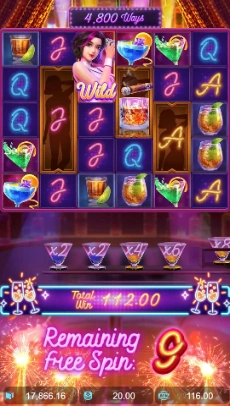
The supplied free-spin example shows nine remaining spins, four current glasses of ×2, ×2, ×4 and ×6, and Total Win 112.00. Nine counts remaining turns; the glass values belong to the multiplier reel; the Total Win field is a money amount. They are not interchangeable inputs.
The four glasses also should not be added simply to produce a headline multiplier of fourteen. Their values would enter a payment calculation only as selected by the winning Wild positions for that win. The whole array and a selected sum are different pieces of information.
The screenshot is a manufacturer example state, not the full record of every spin before it. Its counter and cumulative amount do not establish which specific intervening results occurred, nor guarantee that a later spin will use the largest available value.
Does the advertised maximum win describe the glasses?
The parameter table lists an advertised maximum win of 100,000 times the bet amount. That is a result-limit quantity, distinct from a particular glass value or a selected sum. It does not guarantee a winning sequence or say that a multiplier position will necessarily reach a specified value.
Source: PG SOFT, Cocktail Nights English game information, version 1.0 r939d, pages 3–9 and 11, retrieved 18 November 2026. These are actual manufacturer example game screens, not an author’s play history or a claim that identical settings are currently available on Vegas11.