
The question marks in Spirited Wonders are Mystery symbols. They do not automatically become Wilds as soon as they land. When at least one Mystery is present and there is no more winning combination, all Mystery symbols reveal a randomly selected ordinary symbol before wins are paid.
The lanterns above the grid answer a separate question: which multiplier applies to the current round? The main ladder is ×1, ×2, ×3 and ×5. Free spins triple those values to ×3, ×6, ×9 and ×15. The actual game screens below distinguish the reveal condition, the active lantern and the remaining-spin counter.
The lanterns belong to rounds inside a spin
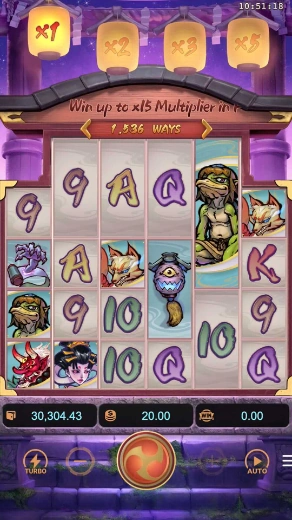
The game has six reels and four rows, with an extra row on each middle reel from two to five. Its stated ways range is 256 to 10,000. The uneven grid and tall character pictures are part of the symbol layout; the lanterns above it provide the multiplier display.
Some ordinary symbols can occupy two to four spaces and still count as one symbol in payout calculations. Wild, Scatter and Mystery are excluded from that large-symbol description. A taller character is not automatically several independent matching symbols.
The first active lantern in the main screen is ×1. The other lantern values remain visible as stages of the ladder, rather than four numbers to add together. The current highlighted stage is what applies to the round under the stated multiplier rule.
Mystery has a condition before it reveals
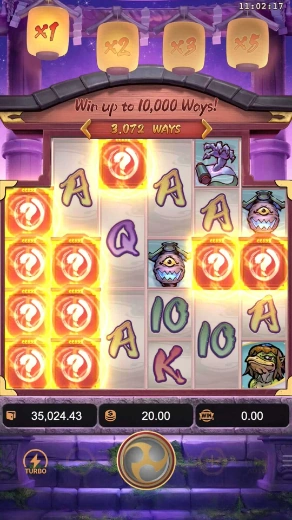
The glowing red question-mark symbols are the Mystery symbols. The formal rule requires one or more of them on the reels and no more winning combination. Under that condition, all the Mystery symbols reveal a randomly selected symbol before wins are paid.
Wild, Scatter and Mystery are excluded from the reveal result. This is why a question mark should not be described as a guaranteed future Wild or as a direct Scatter award. The stated random selection is among eligible ordinary symbols.
Both parts of the condition matter. Merely seeing a Mystery on a screen does not establish that its reveal has already happened. Likewise, the word reveal does not instruct the reader to treat the question-mark picture as an ordinary paying character before the condition has been met.
The image is useful for recognizing the symbol and its place in the interface. It is not a complete animation proving exactly which hidden ordinary picture each mark will produce. The rule supplies the reveal timing and exclusions; the still frame supplies the visible example state.
Wild and Mystery have different jobs
Wilds appear only on reels two, three, four and five. They substitute for symbols except Scatter and Mystery. A Wild can therefore help eligible ordinary-symbol combinations, but it does not stand in for a missing Mystery or a missing Scatter.
Mystery instead changes into an eligible ordinary symbol under its reveal condition. Keeping these roles separate avoids two errors: counting a Wild as an extra Scatter for feature entry, and assuming a Mystery must become a Wild because both can affect what happens on the grid.
Main-game wins advance a ×1, ×2, ×3, ×5 ladder
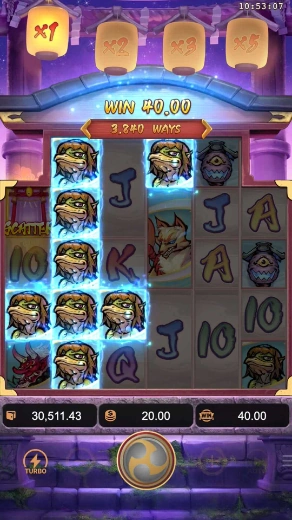
The main-game multiplier starts at ×1 for the first round. A win in that round raises the second round’s multiplier to ×2. A win in round two raises round three to ×3, and a win in round three raises round four and beyond to ×5.
A round here is a stage of the game’s winning sequence inside a spin. It is not a separate instruction to place another paid spin to advance the ladder. The condition for the next stage is the preceding round’s win, not the number of times a player has opened the game.
The supplied first-round example shows ×1 active and WIN 40.00. The active lantern is the relevant multiplier for that state. It does not mean that the three unlit lanterns should also be included or that all the cash fields below the grid are independent wins to multiply again.
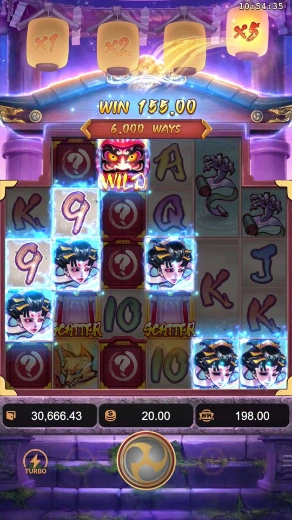
Another manufacturer example has ×5 active, matching the final main-game stage. It is a separate illustration rather than a documented continuous session beginning with the ×1 picture. Its WIN 155.00 field should not be combined with 40.00 to invent a balance history.
For a hypothetical main spin whose first three rounds have underlying winning amounts of 10, 5 and 2, their multiplied amounts are 10 × 1, 5 × 2 and 2 × 3. The total is 26. If no further winning round occurs, there is no additional fourth-round win to assign ×5 to.
Free spins triple each stage, rather than doubling everything

Three Scatters appearing anywhere trigger ten free spins. Each additional Scatter adds two more, and the feature can retrigger. The opening screen says all multipliers are tripled and lists ×3, ×6, ×9 and ×15.
Compare each stage with its main-game counterpart: one becomes three, two becomes six, three becomes nine, and five becomes fifteen. This is a replacement ladder for the feature. It does not mean that the four feature values should be summed to thirty-three.
| Round in a spin | Main-game multiplier | Free-spin counterpart |
|---|---|---|
| First round | ×1 | ×3 |
| Second round after a preceding win | ×2 | ×6 |
| Third round after a preceding win | ×3 | ×9 |
| Fourth and later rounds after preceding wins | ×5 | ×15 |
Applying the same hypothetical underlying amounts of 10, 5 and 2 to the first three feature stages gives 10 × 3 + 5 × 6 + 2 × 9 = 78. The calculation isolates the different ladder. It does not predict a free-spin result or reconstruct any cash amount in the screenshots.
A Mystery screen with ×15 is already in free spins
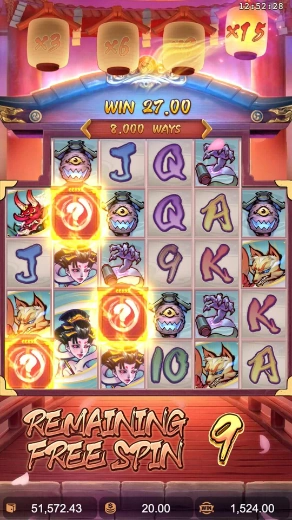
This actual example combines glowing Mystery symbols with an active ×15 lantern and nine remaining free spins. The top row displays the feature values ×3, ×6, ×9 and ×15. It is therefore a feature-state illustration, unlike the main-game Mystery picture with ×1 active.
The two Mystery pictures should not be labelled a before-and-after reveal pair. They have different mode displays and different example states. Neither image by itself shows a completed transition from all the question marks to their revealed ordinary symbols.
The active ×15 also does not change the Mystery exclusions. The formal reveal result still excludes Wild, Scatter and Mystery. A multiplier stage and the kind of symbol a Mystery may reveal remain separate rules even when they appear in the same screen.
An active ×9 and twelve remaining spins measure different things

The separate feature example has ×9 highlighted and twelve free spins remaining. Nine is the multiplier stage; twelve is a count of turns left. The count is not added to nine or multiplied by it to manufacture a new lantern value.
A remaining count greater than the standard ten-spin entry is consistent with the documented extra-spin and retrigger mechanisms, but this still frame does not establish its complete award history. It should not be presented as proof of exactly how many Scatters appeared on every earlier spin.
Similarly, separate pictures with nine and twelve remaining do not establish the order in which an author played them. These are manufacturer examples selected to explain visible rules, rather than a claimed continuous personal session.
Is ×15 the maximum win?
No. Fifteen is the final feature-ladder value in the cited rules. The parameter table separately lists an advertised maximum win of 50,000 times the bet amount. A result limit and a round multiplier have different units and functions; neither guarantees that a future spin will produce a win.
Source: PG SOFT, Spirited Wonders English game information, version 1.0.r939c, pages 3–9, retrieved 18 November 2026. Images preserve actual manufacturer example screens. They do not establish current availability or identical settings on Vegas11 and are not an author’s play history.