
Forge of Wealth has four fixed multiplier slots underneath particular grid positions. A winning symbol over an inactive slot lights it up; a winning symbol over an activated slot supplies a ×2 multiplier contribution. The final calculation uses the total multiplier below the grid. A glowing symbol elsewhere does not automatically collect another two.
That makes position and state equally important. The actual English screenshots below locate all four slots, separate activation from collection, and show why a lower ×6 or ×16 is different from the number of free spins remaining.
Locate the four positions on the actual grid
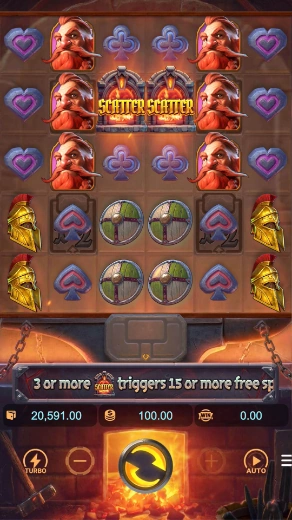
Count columns from the left and rows from the top of the symbol grid. The four stated locations are row two of column two, row four of column two, row two of column five, and row four of column five. You can find their darker position frames in the manufacturer image before following the orange-lit examples.
The pictured grid has six columns across and five rows down. The document’s formal coordinate list is the useful reference for these four positions; this article does not take a conflicting generic parameter label and invent additional multiplier slots. Nor does a tall feature display beneath the grid add another row of ordinary symbols.
| Slot | Column from left | Row from top |
|---|---|---|
| Upper-left feature position | 2 | 2 |
| Lower-left feature position | 2 | 4 |
| Upper-right feature position | 5 | 2 |
| Lower-right feature position | 5 | 4 |
These are fixed grid locations, not particular dwarf, shield or helmet pictures. A different ordinary symbol can fall onto a location as the grid changes. The feature question is which symbol is currently over that slot and whether it belongs to a winning combination.
A slot can be visible without being activated
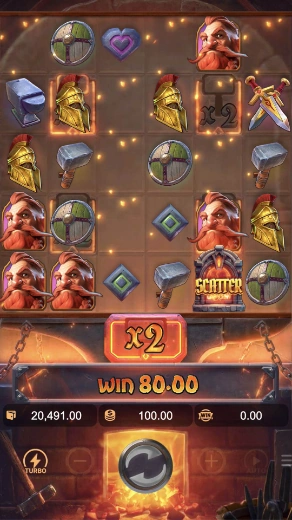
The formal rule distinguishes an inactive multiplier slot from an activated one. A winning symbol above an inactive slot lights and activates that position. A winning symbol above an activated slot collects ×2 for each qualifying activated position. Look at the position’s state as well as the highlighted winning symbols.
The example has orange-lit frames in the special positions, with a ×2 marker at one of them and a lower ×2 total. A visible frame alone is not a cash award. A symbol landing over a frame is also not sufficient without the winning-symbol condition. This is why “there is a dwarf in the second column” is an incomplete description of the feature.
Activation and collection are separate clauses in the rule. They should not be replaced by a general statement that every highlighted picture adds two, or counted as two independent collections merely because both the frame and its symbol animate. When reconciling a specific round, the pre-update slot state and the qualifying winning positions matter.
Collection adds ×2 contributions to the total
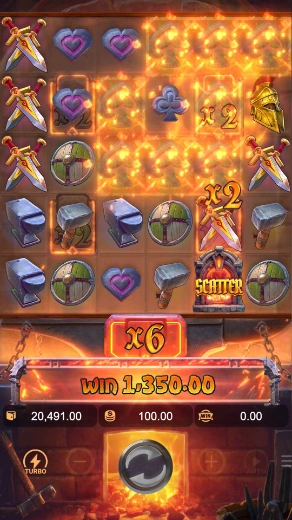
A collection example shows ×2 labels moving near the feature positions while the lower total reads ×6. The rule awards a ×2 contribution for each activated multiplier slot with a winning symbol on top of it. It does not say that every such event multiplies the previously collected total by two.
For a hypothetical contribution count, three confirmed ×2 contributions sum to six. Repeatedly doubling a starting value would be a different operation. The distinction also prevents counting ordinary winning positions elsewhere on the grid as if they were additional fixed multiplier slots.
The grid uses falling-symbol rounds. After a payout, winning symbols explode, other symbols fall into the gaps and the game checks for further combinations. A later round can put a different picture over the same fixed location. Keep the slot’s location separate from the moving symbol above it.
Read the lower total at the end-of-spin calculation
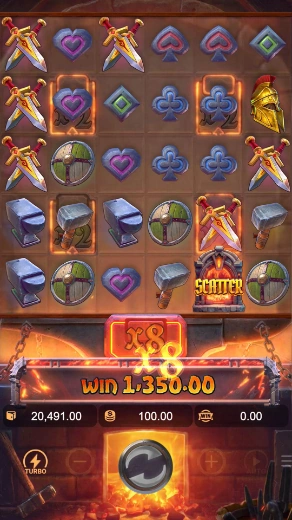
At the end of the spin, its total win is multiplied by the total win multiplier. The supplied ×8 picture shows orange-lit positions and a lower multiplier update with a Win banner. It illustrates the location of the total; it is not a complete ledger showing every preceding contribution and every cash update.
A clean hypothetical calculation is an underlying spin win of 50 with a confirmed total multiplier of six: 50 × 6 = 300. Those invented values explain the end-of-spin operation. They are not an asserted reconstruction of the 1,350.00 banner during the ×8 animation.
The lower multiplier is not the cost of the next spin, and it is not a number of remaining turns. Likewise, the individual ×2 contribution labels are not separate wallet credits. Read the completed result and its applicable total when checking a recorded spin, rather than treating every intermediate label as an additional settled payment.
This illustrated version awards fifteen free spins

The formal free-spins section of the cited document awards 15 free spins for three Scatters anywhere, with two additional spins for every extra Scatter. The supplied opening image clearly displays 15, and the main-screen banner also states that three or more Scatters trigger 15 or more free spins. This article follows that formal section and illustrated client state.
During free spins, the formal rule says the total win multiplier remains after wins are paid, until it is combined with the total multiplier of the next winning free spin. That is a specific retention condition. It should not be shortened to “the next free spin must win,” or treated as a multiplier carried permanently into every later main-game session.
The text also allows free spins to retrigger. A free-spin counter can therefore differ from the initial 15 without changing the initial trigger rule. An intermediate number on one example screen is not a reason to rewrite the entry award.
The free-spin picture contains a multiplier and a counter
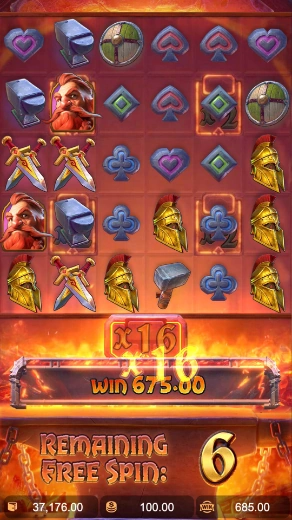
The example shows a lower ×16 animation and six remaining free spins. Sixteen describes the multiplier state; six counts remaining free spins. They are not two parts of a 16-by-six payout formula. The visible Win banner is a cash amount and belongs to a third category of information.
The manufacturer’s separate examples show several multiplier totals during the feature. The article does not present them as a continuous author session, assume that every displayed total includes the same earlier contributions, or invent a missing collection history from the remaining-spin counts. The retained-total wording supplies the rule; a still image identifies a state within it.
Winning symbols and the maximum win have their own tests
The paytable describes wins from eight or more matching symbols appearing anywhere on the grid. That win test is separate from the four fixed multiplier positions. A qualifying combination can involve ordinary positions as well; only winning symbols over the stated activated slots meet the ×2 collection condition.
The specified maximum win is 5,000 times the bet amount. Reaching that total in the main game or free-spins feature ends the spin under the manufacturer’s rule. This is a monetary-result limit, not the number of slots, a fixed ceiling of ×2 on the collected total, or a promise that an activated position will produce a future win.
Does an activated slot turn its symbol into a Wild?
The cited multiplier-slot feature describes activation and ×2 collection from winning symbols over fixed positions. It is not a gold-frame-to-Wild conversion rule. Do not import a different game’s Wild transformation simply because both games highlight special positions.
Do four visible frames mean four collections on every round?
No. The conditions include activation state and a winning symbol over the corresponding position. The existence of four possible slots does not guarantee four qualifying collections, and their state does not predict the next falling-symbol outcome.
Source: PG SOFT, Forge of Wealth English game information, version 1.0.r4, formal sections 2.3–2.5, the supplied game screens and paytable, retrieved 18 November 2026. Images are actual manufacturer examples. The article covers that documented illustrated version without establishing current Vegas11 availability or an author’s play history.